Saturday, July 24, 2021

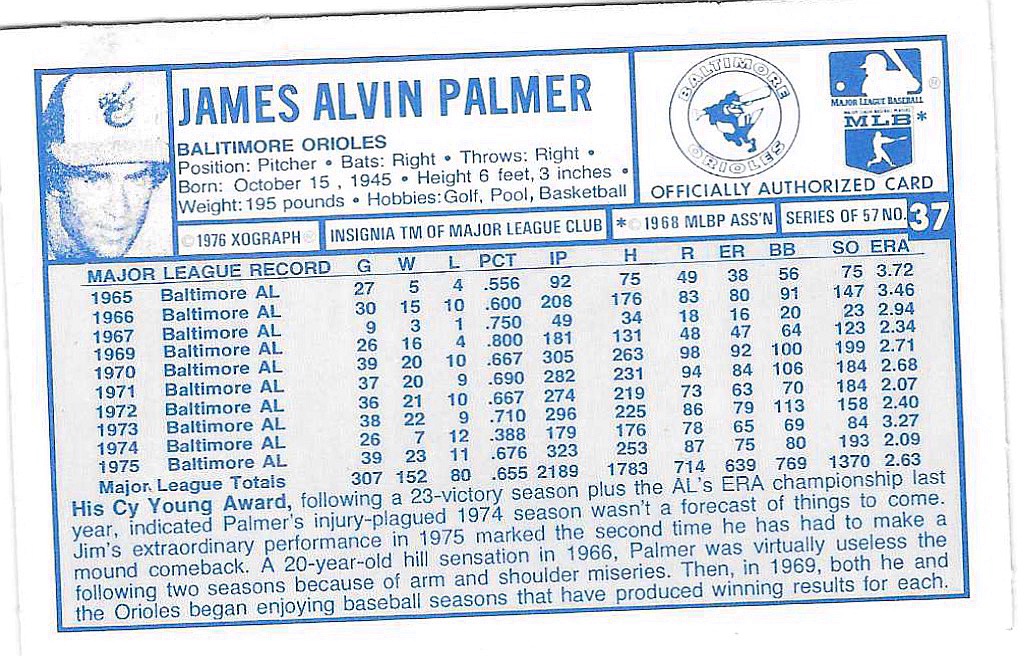
1976 Kellogg's #37 - Jim Palmer

 .


* What did he do to deserve a 1976 Kellogg's card?
    * Multiple Cy Young Award winner
    * Multiple 20 game winner
    * American League ERA leader
    * American League victories leader

* 1976 Highlights:
    * Won his third Cy Young award
    * Led the AL in victories for the second of three straight years

Twitter handle: @Jim22Palmer


Tuesday, July 6, 2021

1976 Kellogg's #55 - Pete Rose


* Another one of the "cards to get" for us in the mid 70s. This one definitely wouldn't have been put in the trade or flip piles.

* What did he do to deserve a 1976 Kellogg's card?
    * As the back of the card says, Pete bounced back from an off year (by his standards) to bat over .300 again.
    * World Series MVP in 1975.
    * Moved to third base partway through the 1975 season so that Sparky could put George Foster in the lineup and complete the Big Red Machine.

* 1976 Highlights:
    * Led the NL with 130 runs scored, 42 doubles, and 215 hits.
    * 4th in MVP voting
    * Started at 3B for the NL in the All Star Game and went 2 for 3 with a triple and a run scored.
    * Only batted .188 in the World Series, but got his second ring.


 .

Sunday, July 4, 2021

1976 Kellogg's #54 - Steve Garvey


* I was a Reds fan at this time, so getting a Dodger card wasn't much fun. But Steve Garvey was one of the prime cards to get no matter what team he played for.
* What did he do to deserve a Kellogg's card?
- MVP award in 1974
- Had another good year in 1975, batting .319 with 210 hits.
- NL All Star both years.
* 1976 Highlights:
- Batted .317 with 200 hits, but it still seemed like an off year due to having only 13 home runs and only 80 RBI
- Made the NL All-Star team for the third straight year
- Third of four straight Gold Glove awards.


 .


Saturday, June 26, 2021

1976 Kellogg's #2 Claudell Washington


  • What did he do to deserve a 1976 Kellogg's card?
    • Made the 1975 AL All Star team as a 20-year-old outfielder
    • The A's didn't have many of their star players left
    • Batted a career-high .308 in 1975
    • Was 14th in AL MVP voting in 1975
  • 1976 Highlights:
    • Dropped to .257 but was still a valuable part of a team that was still a contender in the AL West.

Wednesday, June 9, 2021

1976 Kellogg's #40 - Lou Brock


  • What did he do to deserve a 1976 Kellogg's card?
    • Was an NL All Star in 1975
    • Got some votes for 1975 NL MVP (21st place)
    • Even though he wouldn't get his 3000th hit for a few more years, Lou was probably already pretty close to being a Hall of Famer.
    • He didn't lead the NL in stolen bases in 1975, but he stole over 50 bases for the 11th year in a row. Lou led the NL in stolen bases in eight of those 11 years.
  • 1976 Highlights:
    • Stole 56 bases to extend his 50+ stolen base streak to 12 years.
    • Batted .301, which was the sixth season over .300 in the last seven years

Monday, May 17, 2021

1976 Hostess #142 - Gary Matthews


* Gary Matthews was one of the really good outfielders that the Giants came up with in the early 1970s. Things could have been different if the Giants would have been able to keep Gary Matthews, Garry Maddox, and George Foster.


.


.


Saturday, May 15, 2021

1976 Hostess #41 - John Montefusco


Hello! I finally got to a place where I can spend a bit each month on cards. One thing I decided to do was to work on completing sets from my prime card collecting years (1974-1981). I'm a big Giants fan, so a lot of the first cards I get for these sets will be Giants.

John Montefusco didn't spend much time in the minors. He was dominant in A ball in 1973 and really rose through the system in 1974, going from AA to AAA to the majors all in the same year. I may have seen him pitch in Phoenix in 1974, but I was only seven and don't have any specific memories of the games my dad took me to that year.

John had great  years in 1975 and in 1976 before he started to tail off a bit. Injuries hampered him and by 1979 he was struggling to stay in the rotation.

By the way, the card is in better shape than the scan indicates. I'm still learning how to operate this thing.

Friday, January 4, 2013

1976 Topps Traded - The Missing Cards!


This is something I've been wanting to do, but I lack the graphic skills to pull it off. Ben, Mike, and Travis at The Baseball Card Blog made a "second set" of 1976 Topps Traded cards. This set includes deals that were voided (Vida Blue, Rollie Fingers, Joe Rudi, and Sal Bando) and deals that were made late in the season (such as Willie McCovey).

On the 1977 blog, I've been tracking which cards would be good as a "traded set candidate." I may give it a shot after the Topps set is finished.

Monday, November 7, 2011

On to 1977


  • As you have probably noticed, I've run out of cards to post for 1976. As I obtain the last few cards needed for the 1976 Kellogg's, Hostess, and SSPC sets, I'll post them here.
  • To the best of my knowledge, there aren't any 1977 baseball blogs out there. So I'm starting one. I hope you go and start enjoying the blog


Sunday, September 25, 2011

1976 Hostess #124 - Willie McCovey


  • Willie McCovey was still a dangerous power hitter when this card was printed
  • McCovey wanted to play out his option in 1976 so the Padres cut his salary by 20% to $100,000.
  • The San Francisco Giants wanted Willie back before the 1976 season. The Giants had traded McCovey to the Padres in 1973 mainly for economic reasons.
  • McCovey had his poorest season in 1976. He played in 71 games for the Padres, starting 51 of those games at first base. Willie batted .203 with 7 HR and 36 RBI for the Padres.
  • Willie was sold to the Oakland A's on August 30.
  • McCovey wasn't sure if he would report to the A's at first, but he reported on September 1.
  • The A's used Willie as a DH and a pinch hitter in September, but Willie struggled and batted .208 (5 for 24) with no home runs or RBI.
  • After his poor 1976 season there wasn't very much interest in McCovey in the free agent  market. Willie ended up signing with the Giants for $50,000 and had a great year in 1977, winning Comeback Player of the Year honors and cementing his place as an eventual Hall of Famer.
  • Before peak, peak, or after peak? after peak


Saturday, September 24, 2011

1976 Hostess #105 - Dave Lopes


  • Here's another beat up Hostess card that I got from a lot on eBay.
  • Lopes was the first  Dodger to sign a contract for the 1976 season.
  • Before the 1976 season there was some talk of moving Lopes to shortstop and playing Ted Sizemore at second base. Dodger shortstop Bill Russell was mentioned in trade talks between the Dodgers and the St. Louis Cardinals for Reggie Smith, but he eventually stayed with the club.
  • Dave was still playing a little bit in center field in 1976. After the 1976 season Lopes would play all of his games but two at 2B until he moved to the Oakland A's in 1982.
  • In 1976 Lopes led the NL with 63 stolen bases and batted .241 in 117 games
  • Dave missed the first month of the 1976 due to a pulled muscle in his side that he suffered during spring training.
  • Before peak, peak, or after peak? early peak


Friday, September 23, 2011

1976 Hostess #92 - John Candelaria


  • This card is a victim of some kid's poor cutting skills. Hey kid----the lines are your friends! ;)
  • This card was printed right at the beginning of a nice career.
  • The Pirates didn't win the NL East in 1976, but John did his part to keep the club competitive. Candelaria was 16-7 with a 3.15 ERA during the season.
  • John pitched a no-hitter against the Los Angeles Dodgers on national television on August 9. A third inning walk to Steve Yeager and two Pirate errors were the only things that prevented Candelaria from pitching a perfect game.
  • Before peak, peak, or after peak? just before peak --- John's best year was 1977.


Sunday, September 18, 2011

1976 Hostess #53 - Jim Hughes


  • Jim Hughes got this Hostess card on the strength of his good 1975 rookie season.
  • Hughes was bitten by the sophomore  jinx in 1976. He had a 9-14 record with a 4.98 ERA
  • Jim was in the minors for most of the 1977 season -- he appeared in two April games for the Twins before being sent to AAA.
  • Hughes signed with the Chicago White Sox after the 1977 season but was cut during spring training in 1978. 
  • Jim signed with the Texas Rangers and spent a couple of years in the minors but never made it back to the major leagues.
  • Before peak, peak, or after peak? after peak


Saturday, September 17, 2011

1976 Hostess #25 - Larry Dierker


  • Larry Dierker was only 29 years old, but he was just about at the end of his career when this card was printed
  • Larry had a 13-14 record with a 3.69 ERA in his last full season in 1976
  • On July 9, 1976 Dierker pitched a no-hitter against the Montreal Expos
  • After 14 seasons with the Houston Astros, Dierker was traded to the St. Louis Cardinals after the 1976 season
  • Before peak, peak, or after peak? after peak


Friday, September 16, 2011

1976 Hostess #12 - Rick Manning


  • After posting decent numbers in the minors from 1972-1974, Rick Manning earned a promotion to the  majors at the age of 20 in 1975 after a good start in AAA Oklahoma City.
  • Rick's best two seasons were in 1975 and in 1976
  • In 1976 Manning won a Gold Glove award and batted .292 in 138 games
  • Rick broke up a no-hit bid by the Rangers' Steve Hargan on August 15 by doubling in the 7th inning.
  • Before peak, peak, or after peak? peak


Friday, September 2, 2011

1976 Hostess #142 - Gary Matthews


  • Gary Matthews was one of the unsung young stars of the game in 1976. Playing for several bad Giants teams didn't help him gain much notoriety.
  • In 1976 Matthews batted .279 with 20 HR and 84 RBI.
  • After the 1976 season Gary signed a multi-year contract with the Atlanta Braves.
  • The Braves lost a first round draft choice and were fined for contacting Matthews without permission before the opening of the free agent season.
  • Before peak, peak, or after peak? peak


Thursday, September 1, 2011

1976 Hostess #150 - Cesar Geronimo


  • Cesar Geronimo was a good fielder and had a great arm. He won four straight Gold Gloves from 1974-1977
  • Offensively, this five-year run is decent, but not awe-inspiring. Cesar had a nice year in 1974 -- it was the first year that he started more than 100 games.
  • In 1976 Geronimo had his best offensive year. He batted .307, hit 11 triples, and stole 22 bases. Cesar also had a .382 on base percentage.
  • Before peak, peak, or after peak? peak


Wednesday, August 31, 2011

1976 Hostess #134 - Don Kessinger


  • Don Kessinger had spent 11 seasons as the shortstop for the Chicago Cubs. He was traded to the St. Louis Cardinals after the 1975 season.
  • Kessinger was expected to help provide leadership for a young infield. Cardinals manager Red Schoendienst placed Don in the #2 spot behind leadoff hitter Lou Brock.
  • Don played one full season for the Cardinals in 1976, batting .243 in 145 games. 
  • The emergence of Garry Templeton in 1977 relegated Kessinger to a utility role. Don was traded to the Chicago White Sox in August 1977.
  • Before peak, peak, or after peak? after peak


Tuesday, August 30, 2011

1976 Hostess #128 - Dave Concepcion


  • Dave Concepcion established himself as the Reds' starting shortstop in 1973. He didn't play a full season in '73 due to an injury.
  • In 1975 Dave started a string of All Star appearances that would last through the 1982 season
  • According to a poll of National League players, Dave would not have been the NL starting shortstop in the All Star Game if players had voted. Larry Bowa would have been the starter instead.
  • Concepcion had a  typically good season in 1976. He batted .281 with 9 home runs and 21 stolen bases. He won the second of five Gold Glove awards.
  • Dave was voted to the Associated Press All Star Team after the 1976 season.
  • Before peak, peak, or after peak? peak
  • After the 1976 season Dave and teammate  Tony Perez voiced frustration about how Latin ballplayers were forgotten and underrated.


Sunday, August 28, 2011

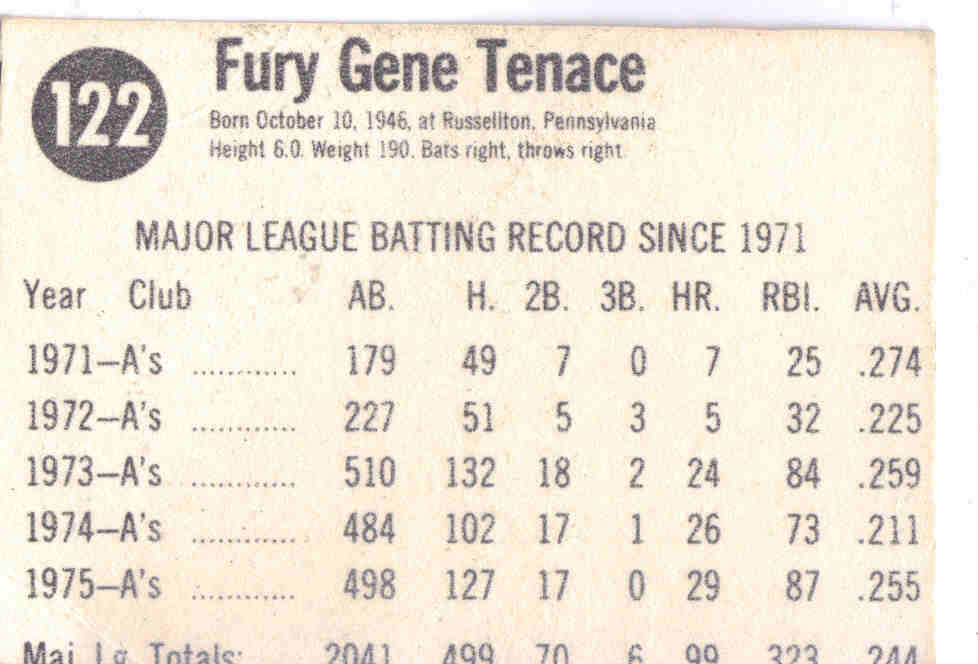
1976 Hostess #122 - Gene Tenace


  • As the card back shows, Gene Tenace was a part-time player until 1973. 
  • Tenace spent most of 1973 playing first base, then he was behind the plate for about 2/3 of the time in 1974. Gene played catcher for about 3/4 of his games in 1975.
  • Gene had some good power years from 1973-1975, averaging 26.3 home runs per season.
  • Tenace was an AL All Star in 1975 and also got a little bit of MVP support (18th in MVP voting)
  • Gene played in only 128 games in 1976. Tenace strained his left knee sliding into second base on April 20. It was thought that he would miss 10-14 days, but he ended up missing five weeks.
  • Tenace batted .249 with 22 HR and 66 RBI. It was the only year from 1973-1979 that he didn't walk over 100 times (he had 81 bases on balls)
  • After the 1976 season Tenace signed a six-year, $1.8 million contract with the San Diego Padres. He made $40,800 in 1976, so the pact represented a huge raise for Gene.
  • Before peak, peak, or after peak? after peak (barely)