skip to main |
skip to sidebar


- Ted Simmons was a good catcher who was overshadowed by Johnny Bench, Carlton Fisk, Thurman Munson, and Gary Carter. There were quite a few good catchers in the 70s. If he would have had a better decline phase, he would probably be in the Hall of Fame. Although he put up good offensive numbers, the fact that he didn't lead the league in any of the major categories during his career probably works against him. Looking strictly at the numbers, Ted's defense was at league average during his career. Here is a Hardball Times article that examines the pros and cons of Ted Simmons belonging in the Hall of Fame
- Ted Simmons was the first round draft pick of the St. Louis Cardinals in 1967. Simmons started in the minors as a 17-year-old in '67 and tore up the minors from 1968-1970. Ted had two late season looks in 1968 and 1969. In late May 1970 Simmons came up to the majors for good. He batted .243 in 82 games.
- In 1971 Simmons became the regular catcher. Ted batted .303 with 7 HR and 77 RBI in 133 games. He would play in at least 140 games in every season but 1979 (123 games) for the rest of his tenure with the Cardinals.
- Ted started to develop some power in 1972 (he was still only 22 years old) and hit 16 homers. Ted batted .303 that season and was selected to the first of eight All Star games (six for the Cardinals and two for the Milwaukee Brewers).
- In 1973 Ted was an All Star again (he went 0 for 1) and batted .310 with 13 HR and 90 RBI. Simmons had a lower batting average (.272) in 1974 but hit for more power (20 HR, 103 RBI). He was selected to the All Star game but didn't get in the game.
- Simmons had what was probably his best year in 1975 but wasn't selected to the All Star Game. He batted .332 with 18 HR and 100 RBI and was 6th in NL MVP voting. Ted's power numbers were way down in 1976 -- he batted .291 but hit only five home runs and knocked in only 75 runs.
- In 1977 Ted had another good year (.318, 21 HR, 95 RBI), made the All Star team (he was 0 for 3 as a sub for Johnny Bench), and was 9th in MVP voting. Simmons was voted to the 1978 All Star Game as a starter by the fans. He went 1 for 3 in the game. Ted batted .287 with 22 HR and 80 RBI in '78.
- Ted batted .286 with a career-high 26 home runs in 1979. He was on the 1979 NL All Star team but didn't play. The team had five catchers (Bench, Simmons, Gary Carter, John Stearns, and starter Bob Boone) that year. His final year with the Cardinals was 1980. Simmons batted .303 with 21 HR and 98 RBI. Ted didn't get along with new manager Whitey Herzog. He was packaged with Rollie Fingers and Pete Vuckovich in a big trade with the Milwaukee Brewers after the 1980 season.
- Simmons made the AL All Star team in 1981 (he had a pinch hit RBI single) although he had an awful year. He batted .216 with 14 HR and 61 RBI. Ted batted .222 in the 1981 ALDS. Simmons had a better year for the Brewers in 1982 -- he batted .269 with 23 HR and 97 RBI. He didn't do much in the post season (.167 in the ALCS and .174 in the World Series).
- In 1983 Ted made the All Star team for the last time. He was the starting catcher for the American League and went 0 for 2. He batted .308 with 13 RBI and 108 RBI in '83. By this time Ted was spending more time as the designated hitter. After the 1983 season Simmons became a free agent and decided to resign with the Brewers.
- The 1984 season was Ted's worst season as a regular player. He batted .221 with 4 HR and 52 RBI. Simmons had a better year in 1985, his last as a regular player. He batted .273 with 12 HR and 76 RBI. During spring training in 1986 the Brewers traded Simmons to the Atlanta Braves for Rick Cerone and two minor leaguers.
- Simmons spent the last three seasons of his career as a pinch hitter and backup for the Braves. After the 1988 season Ted retired and was hired by ex-teammate Dal Maxvill as Director of Player Development for the Cardinals.
- After his playing career Simmons was a front office executive for several years. He became the General Manager of the Pittsburgh Pirates in 1992 but stepped down in June 1993 after he had a heart attack. Ted was Director of Player Development for the Cardinals and the San Diego Padres. He was the bench coach for the Brewers in 2008 and for the Padres in 2009.
- Baseball Prospectus 2008 interview with Simmons
- Liked to face: Burt Hooton (.345 in 87 AB); Rick Reuschel (.357 in 84 AB); Ernie McAnally (.552 in 29 AB); Jack Billingham (.444 in 45 AB)
- Hated to face: Jack Morris (.158 in 38 AB); Ed Whitson (.111 in 27 AB); Frank Tanana (.063 in 32 AB); Phil Niekro (.203 in 79 AB)


- Enzo Hernandez is showing what was probably his best baseball skill -- bunting the baseball. He was usually in double figures in sacrifices and led the NL with 24 in 1975. Hernandez was signed by the Houston Astros in 1967. He played in the Houston farm system in 1967 and 1968 and then was involved in the big trade that sent Mike Cuellar to the Baltimore Orioles. Enzo played in the Baltimore system in 1969 and 1970 and then was traded to the San Diego Padres.
- Hernandez became the starting shortstop for the Padres in 1971. He played in 143 games and had 618 plate appearances but somehow managed to drive in only 12 runs. Enzo batted .222 and all but 12 of his 122 hits were singles. He was the "Triple Crown Loser" in '71, finishing last among eligible batters in batting average, home runs (0), and RBI.
- In 1972 Enzo played in fewer games (114) and batted .195 in 329 AB. He had a nice stolen base percentage -- 24 stolen bases and 3 caught stealing. Hernandez missed almost six weeks of the 1973 season from mid June to late July and lost his starting shortstop job to Darrell Thomas. He appeared in 70 games and batted .223 in 247 AB.
- Enzo regained his starting SS job in 1974 and batted .232 in 512 at bats. He stole a career-high 37 bases in '74. In 1975 Hernandez played in 114 games and batted .218 in 344 at bats.
- Hernandez had his best offensive year in 1976. He batted .256 in 340 at bats. In 1977 Enzo played in only seven games in April. Six of those games were as a late-inning defensive replacement. Enzo was 0 for 3 in the only game he started. He may have been hurt since there is no record of him playing in the minors that year.
- In 1978 Enzo was cut during spring training and signed with the Los Angeles Dodgers. He spent most of the year in AAA Albuquerque. He appeared in four games in August and was 0 for 3 before being released on August 25.
- Liked to face: Jerry Koosman (.306 in 36 AB); Jim Barr (.344 in 32 AB); Bob Gibson (.300 in 30 AB); Doug Rau (.440 in 24 AB)
- Hated to face: Tom Seaver (.136 in 44 AB); Gary Nolan (.147 in 34 AB); Andy Messersmith (.138 in 29 AB); Juan Marichal (.125 in 24 AB)


- Bill Campbell pitched for seven teams from 1973-1987. He was one of the first players to sign a big contract during the free agent era. Bill was singed by the Minnesota Twins in 1970. He began his career as a starting pitcher, making only one relief appearance in his three years in the minors. Campbell was called up to the Twins in mid July 1973. He pitched in 28 games (2 starts) and was 3-3 with 7 saves and an ERA of 3.14.
- Campbell became an important part of the Minnesota bullpen in 1974. He appeared in 62 games and had 19 saves, an 8-7 record, and an ERA of 2.62. In 1975 the Twins had Bill start a few games. Campbell appeared in 47 games and started seven times. He had a record of 4-6 with 5 saves and an ERA of 3.79.
- Bill had a great year in 1976. He led the AL in appearances with 78 and was 17-5 with 20 saves and a 3.01 ERA. Campbell led the AL in winning percentage (.778). Bill pitched 167 2/3 innings in relief during the '76 season. He got some Cy Young consideration (7th) and MVP consideration (8th) and was the AL Fireman of the Year. After the '76 season Campbell became a free agent and signed a big contract ($1 million for four years) with the Boston Red Sox. He was the first player from the first free agent class to sign a contract.
- The Red Sox received some immediate dividends from Campbell in 1977. Bill was AL Fireman of the Year for the second year in a row and made the AL All Star team (he pitched a scoreless 7th inning). He was 5th in Cy Young Award voting and 10th in MVP voting and was again the AL Fireman of the Year. Campbell had a record of 13-9 with an ERA of 2.96 and led the AL with 31 saves.
- In 1978 Campbell experienced arm trouble. He didn't pitch for four weeks in late April and May. He was used about 1-2 times a week and pitched only 50 2/3 innings. He had a 7-5 record with 4 saves and a 3.91 ERA. Bill appeared in more games in 1979 (41 compared to 29 in '78) but pitched only 54 2/3 innings. He was 3-4 with 9 saves and a 4.28 ERA.
- During the 1980 season Bill didn't pitch until June 20. He made only 23 appearances, the lowest number until his last season. Bill was 4-0 with a 4.79 ERA. Campbell was 1-1 with 9 saves and a 3.17 ERA in 30 appearances in 1981. After the season he became a free agent and signed with the Chicago Cubs.
- Campbell was able to come back in 1982 and pitch 100 innings, the most since 1977. In his 62 appearances he was 3-6 with 8 saves and a 3.69 ERA. Bill led the NL with 82 appearances in 1983 and was 6-8 with 8 saves and a 4.49 ERA. After the 1983 season he and Mike Diaz were traded to the Philadelphia Phillies for Gary Matthews, Bob Dernier, and Porti Altamirano.
- Bill was a middle reliever for the Phillies in 1984. He had a 6-5 record with one save and a 3.53 ERA in 57 games. At the end of spring training in 1985 he and Ivan DeJesus were traded to the St. Louis Cardinals for Dave Rucker.
- Campbell finally made it to the postseason in 1985. He made 50 appearances and was 5-3 with 4 saves and a 3.50 ERA during the season. Bill made three appearances in the NLCS and three appearances in the World Series and allowed one run in 6.1 innings. Campbell was released after the season and hooked up with the Detroit Tigers.
- Bill spent one season with the Tigers (3-6, 3 saves, 3.88 ERA) and was released after the '86 season. He signed with the Montreal Expos but was released in May 1987 after making seven appearances and having an ERA of 8.10.
- Liked to face: Buddy Bell (.120 in 25 AB); Bert Campaneris (.130 in 23 AB); Reggie Jackson (.167 in 36 AB)
- Hated to face: Claudell Washington (.389 in 36 AB); Johnny Ray (.563 in 16 AB); Gene Tenace (.563 in 16 AB)


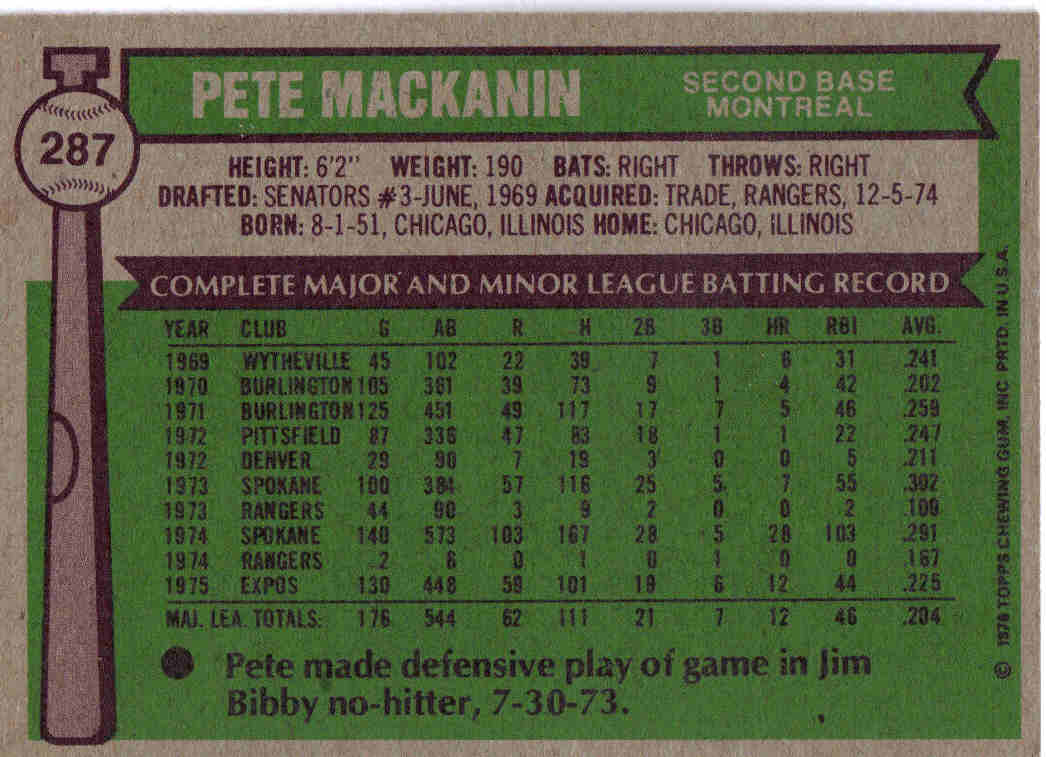
- Pete Mackanin had a nine-year career for four teams from 1973-1981. Pete was drafted by the Washington Senators in 1969, when he was 17 years old. He didn't exactly set the minors on fire from 1969-1972 (his highest average was .259 in 1971).
- In 1973 Pete batted .302 for AAA Spokane and the Texas Rangers called him up in July. He batted .100 in 90 at bats. Pete went back to Spokane in 1974 and batted .291 with 28 HR and 103 RBI. He got to play in two games for the Rangers (.167 in six AB). After the 1974 season Pete was traded with Don Stanhouse to the Montreal Expos for Willie Davis.
- Mackanin became Montreal's starting second baseman in 1975. He batted .225 with 12 HR and 44 RBI in 130 games. Pete started 90 games at 2B in 1976 and also filled in at the other infield positions. He batted .224 in 380 AB with 8 HR. Mackanin had a propensity to strike out -- he whiffed 99 times in '75 and 66 times in '76 (about 3 times more strikeouts than walks).
- Pete's playing time was sharply curtailed in 1977. He appeared in 55 games and batted .224 in 85 at bats. Mackanin spent most of the 1978 playing for Montreal's AAA Denver club. He had a good year for Denver -- .276 with 17 HR and 112 RBI. The Philadelphia Phillies selected Pete off of waivers in early September and he was 2 for 8 in five games.
- Mackanin didn't play a whole lot in 1979. He played in five games in April then he didn't appear again until September. Pete was 1 for 9 in 13 games in '79. After the season he was traded to the Minnesota Twins for Paul Thormodsgard. In 1980 Pete started 60 games at 2B and 23 games at SS. He played in 108 games and batted .266. He was a utility guy in 1981 and batted .231 in 77 games.
- After the 1981 season Pete became a free agent and signed with the Chicago White Sox. Mackanin didn't make the club in 1982 and was cut loose. He played in the minors from 1982-1984 but was never called up.
- After his playing career Pete has had a long career as a manager, scout, and coach. He managed in the minors from 1985-1986, 1988-1996, 2001-2002, and 2006. Pete had two stints as a major league interim manager -- 2005 for the Pittsburgh Pirates and 2007 for the Cincinnati Reds. He is currently the bench coach for the Philadelphia Phillies.
- Liked to face: Pete Falcone (.389 in 18 AB); Mike Caldwell (.333 in 27 AB); Jon Matlack (.300 in 30 AB)
- Hated to face: Paul Splittorff (.059 in 17 AB); Jerry Koosman (.188 in 32 AB); Gene Garber (.118 in 17 AB)


- Jim Wohlford played for four teams from 1972-1986. Wohlford was drafted by the Kansas City Royals in 1970. He had good years in the minors from 1970-1972 (.308, .301, .291) and was called up to the Royals in September 1972. Jim batted .240 in 25 AB at the end of the 1972 season.
- In 1973 Jim split time between the Royals and AAA Omaha. He batted .319 in 65 games for Omaha and .266 in 45 games for the KC Royals. Jim became the starting left fielder in 1974 and batted .271 in 143 games. Jim was in double figures in stolen bases from 1974-1977 but didn't have much power.
- Wohlford started 84 games in either in LF or RF in 1975. He played in a total of 116 games and batted .255. In 1976 Jim was more of a 4th outfielder and backup guy -- he played in 107 games but batted only 334 times. Jim batted .249 in the regular season and .167 in 12 at bats in the ALCS.
- Jim was traded with Bob McClure and Jamie Quirk to the Milwaukee Brewers before the 1977 season for Jim Colborn and Darrell Porter. Wohlford became the starting LF for the Brewers in 1977 and batted .248 in 391 at bats. It would be his last year as a starting player.
- Wohlford played two more seasons as a backup player. He batted .297 in 118 at bats in 1978 and .263 in 175 at bats in 1979. After the 1979 season Jim became a free agent and signed with the San Francisco Giants.
- Jim's best year with the Giants was 1980. He batted .280 in 91 games (193 at bats) as a backup outfielder and third baseman. He slumped badly in 1981, batting .162 in 68 at bats. Wohlford had a better year in 1982 (.256 in 250 AB). Jim was traded to the Montreal Expos for Chris Smith before the 1983 season.
- Wohlford did pretty well with the Expos in 1983 and 1984. In '83 he batted .277 in 141 at bats. In '84 Jim batted .300 in 213 at bats. In 1985 Wohlford had an off-year, batting .192 in 125 at bats. Jim batted .266 in 94 at bats in 1986 and was released after the season. He tried to hook on with the Cincinnati Reds in July 1987 and played for the Reds' AAA Nashville club but he hung 'em up after batting .210 in 33 games.
- Jim now works as a financial planner in his home town of Visalia, CA.
- Quote: "Ninety percent of this game is half-mental." The quote has often been attributed to Yogi Berra, but Jim was the one who actually said it. He got a $50 check from Reader's Digest for the quote being used in its Notable Quotables.
- Another quote: On the home of the San Francisco Giants, he said, "the only difference between Candlestick and San Quentin is that at Candlestick they let you go home at night."
- When he was with the Royals Jim wore number 6 in honor of Al Kaline, a player he admired.
- Liked to face: Bill Lee (.348 in 46 AB); Ed Figueroa (.357 in 28 AB); Jim Hunter (.346 in 26 AB); Shane Rawley (.346 in 26 AB)
- Hated to face: Larry McWilliams (.154 in 39 AB); Fergie Jenkins (.158 in 38 AB); Claude Osteen (.111 in 18 AB); Gaylord Perry (.105 in 19 AB)

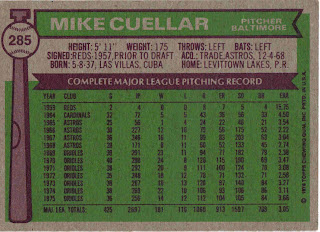
- Mike Cuellar had a long career mostly with the Baltimore Orioles and the Houston Astros. He was signed by the Cincinnati Reds in 1957 and pitched in Havana for the next few years. Mike got a quick 2-game look in 1959 (2 innings, 7 runs allowed). Cuellar continued to pitch in the Reds' organization through the 1962 season.
- Before the 1963 season Cuellar went to the Detroit Tigers organization. He pitched for a short time for AA Knoxville, then went to the Cleveland Indians organization in another "unknown transaction." Mike finished the '63 season with AAA Jacksonville. Before the 1964 season Mike was sent to the St. Louis Cardinals. He pitched in AAA Jacksonville (now a farm team of the Cardinals) in 1964 and was called up in mid-June. Mike pitched in 32 games (7 starts) for the Cardinals and was 5-5 with a 4.50 ERA.
- In 1965 Cuellar started the season with Jacksonville. On June 15 he was traded with Ron Taylor to the Houston Astros for Chuck Taylor and Hal Woodeshick. Mike was 1-4 with two saves in 25 games (4 starts) and an ERA of 3.54 for the Astros in 1965.
- At the age of 29 in 1966 Cuellar finally got a chance to start regularly in the major leagues. He was 12-10 with a 2.22 ERA in 28 starts in 1966. Mike also relieved ten times and notched two saves. In 1967 Mike was 16-11 with a 3.03 ERA. Cuellar made the NL All Star team in 1967 and pitched two scoreless innings. He fell off a bit in 1968 (8-11, 2.74 ERA in 24 starts). After the 1968 season Cuellar was traded with a minor leaguer and Enzo Hernandez to the Baltimore Orioles for Curt Blefary and a minor leaguer.
- Cuellar paid immediate dividends for the Orioles in 1969. He was the AL Cy Young Award winner, going 23-11 with a 2.38 ERA in 39 starts. Mike had no decision in 8 innings in game 1 of the ALCS and got Baltimore's only victory in the World Series (game 1).
- Mike led the AL with 24 wins in 1970. He was 24-8 with a 3.40 ERA and also led the league in starts (40) and complete games (21). Cuellar was rocked in his only ALCS appearance but was the winning pitcher in game 5 of the World Series (the final game of the series). Mike was the first batter to hit a grand slam in a league championship series in 1970. He made the All Star team in 1970 but wasn't used.
- Cuellar won over 20 games for the third season in a row in 1971. He was 20-9 with a 3.08 ERA and won game 2 of the ALCS. Mike lost both of his starts in the World Series (games 3 and 7), although he allowed only 2 runs in 8 innings in the final game. Mike made his third straight All Star team and pitched two shutout innings. On August 16, 1971 Cuellar gave up Harmon Killebrew's 500th home run.
- Mike won 18 games in both 1972 and 1973. In 1973 Mike lost a tough one in game 3 of the ALCS. He and Ken Holtzman were locked up in a 1-1 duel when Bert Campaneris homered in the bottom of the 11th to win it for the Oakland A's.
- In 1974 Cuellar was 22-10 (the last time he would win over 20) with a 3.11 ERA. He led the AL with a .688 winning percentage. He won game 1 of the ALCS and was the losing pitcher in game 4 (1 run in 5 innings). Mike made the AL All Star team but wasn't used.
- At the age of 38 Mike started on the downward slope of his career in 1975. He was 14-12 in 36 starts but his ERA went up to 3.88. Cuellar had a really rough year in 1976 - he was 4-13 with a 4.96 ERA in 19 starts. He was demoted to the bullpen during the All Star break and used sparingly after mid-July.
- The Orioles released Mike after the 1976 season and he signed with the California Angels. Mike was 0-1 with an 18.90 ERA in two games (1 start) when the Angels cut him loose on May 16, 1977. He attempted a comeback in 1979 and was 7-6 for three clubs in the Puerto Rican and Mexican Leagues.
- Mike now lives in Orlando, FL and participates in the Hispanic Heritage Month event.
- Edit: Mike died of stomach cancer on 2 April 2010.
- Quote: "I gave Mike Cuellar more chances than my first wife." - Earl Weaver
- Elrod Hendricks said that Mike Cuellar was the best musician on the team. "He could play conga drums with good rhythm." He also ranked Mike as having the best curveball and as being one of his favorite teammates.
- Liked to face: Tommy Harper (.192 in 99 AB); Rico Petrocelli (.183 in 60 AB); Deron Johnson (.103 in 58 AB)
- Hated to face: Felipe Alou (.345 in 87 AB); Rod Carew (.349 in 63 AB); Joe Rudi (.362 in 58 AB); Frank Howard (.310, 6 HR in 58 AB)