Showing posts with label 1976 Hostess. Show all posts

Monday, May 17, 2021

1976 Hostess #142 - Gary Matthews


* Gary Matthews was one of the really good outfielders that the Giants came up with in the early 1970s. Things could have been different if the Giants would have been able to keep Gary Matthews, Garry Maddox, and George Foster.


.


.


Saturday, May 15, 2021

1976 Hostess #41 - John Montefusco


Hello! I finally got to a place where I can spend a bit each month on cards. One thing I decided to do was to work on completing sets from my prime card collecting years (1974-1981). I'm a big Giants fan, so a lot of the first cards I get for these sets will be Giants.

John Montefusco didn't spend much time in the minors. He was dominant in A ball in 1973 and really rose through the system in 1974, going from AA to AAA to the majors all in the same year. I may have seen him pitch in Phoenix in 1974, but I was only seven and don't have any specific memories of the games my dad took me to that year.

John had great  years in 1975 and in 1976 before he started to tail off a bit. Injuries hampered him and by 1979 he was struggling to stay in the rotation.

By the way, the card is in better shape than the scan indicates. I'm still learning how to operate this thing.

Sunday, September 25, 2011

1976 Hostess #124 - Willie McCovey


  • Willie McCovey was still a dangerous power hitter when this card was printed
  • McCovey wanted to play out his option in 1976 so the Padres cut his salary by 20% to $100,000.
  • The San Francisco Giants wanted Willie back before the 1976 season. The Giants had traded McCovey to the Padres in 1973 mainly for economic reasons.
  • McCovey had his poorest season in 1976. He played in 71 games for the Padres, starting 51 of those games at first base. Willie batted .203 with 7 HR and 36 RBI for the Padres.
  • Willie was sold to the Oakland A's on August 30.
  • McCovey wasn't sure if he would report to the A's at first, but he reported on September 1.
  • The A's used Willie as a DH and a pinch hitter in September, but Willie struggled and batted .208 (5 for 24) with no home runs or RBI.
  • After his poor 1976 season there wasn't very much interest in McCovey in the free agent  market. Willie ended up signing with the Giants for $50,000 and had a great year in 1977, winning Comeback Player of the Year honors and cementing his place as an eventual Hall of Famer.
  • Before peak, peak, or after peak? after peak


Saturday, September 24, 2011

1976 Hostess #105 - Dave Lopes


  • Here's another beat up Hostess card that I got from a lot on eBay.
  • Lopes was the first  Dodger to sign a contract for the 1976 season.
  • Before the 1976 season there was some talk of moving Lopes to shortstop and playing Ted Sizemore at second base. Dodger shortstop Bill Russell was mentioned in trade talks between the Dodgers and the St. Louis Cardinals for Reggie Smith, but he eventually stayed with the club.
  • Dave was still playing a little bit in center field in 1976. After the 1976 season Lopes would play all of his games but two at 2B until he moved to the Oakland A's in 1982.
  • In 1976 Lopes led the NL with 63 stolen bases and batted .241 in 117 games
  • Dave missed the first month of the 1976 due to a pulled muscle in his side that he suffered during spring training.
  • Before peak, peak, or after peak? early peak


Friday, September 23, 2011

1976 Hostess #92 - John Candelaria


  • This card is a victim of some kid's poor cutting skills. Hey kid----the lines are your friends! ;)
  • This card was printed right at the beginning of a nice career.
  • The Pirates didn't win the NL East in 1976, but John did his part to keep the club competitive. Candelaria was 16-7 with a 3.15 ERA during the season.
  • John pitched a no-hitter against the Los Angeles Dodgers on national television on August 9. A third inning walk to Steve Yeager and two Pirate errors were the only things that prevented Candelaria from pitching a perfect game.
  • Before peak, peak, or after peak? just before peak --- John's best year was 1977.


Sunday, September 18, 2011

1976 Hostess #53 - Jim Hughes


  • Jim Hughes got this Hostess card on the strength of his good 1975 rookie season.
  • Hughes was bitten by the sophomore  jinx in 1976. He had a 9-14 record with a 4.98 ERA
  • Jim was in the minors for most of the 1977 season -- he appeared in two April games for the Twins before being sent to AAA.
  • Hughes signed with the Chicago White Sox after the 1977 season but was cut during spring training in 1978. 
  • Jim signed with the Texas Rangers and spent a couple of years in the minors but never made it back to the major leagues.
  • Before peak, peak, or after peak? after peak


Saturday, September 17, 2011

1976 Hostess #25 - Larry Dierker


  • Larry Dierker was only 29 years old, but he was just about at the end of his career when this card was printed
  • Larry had a 13-14 record with a 3.69 ERA in his last full season in 1976
  • On July 9, 1976 Dierker pitched a no-hitter against the Montreal Expos
  • After 14 seasons with the Houston Astros, Dierker was traded to the St. Louis Cardinals after the 1976 season
  • Before peak, peak, or after peak? after peak


Friday, September 16, 2011

1976 Hostess #12 - Rick Manning


  • After posting decent numbers in the minors from 1972-1974, Rick Manning earned a promotion to the  majors at the age of 20 in 1975 after a good start in AAA Oklahoma City.
  • Rick's best two seasons were in 1975 and in 1976
  • In 1976 Manning won a Gold Glove award and batted .292 in 138 games
  • Rick broke up a no-hit bid by the Rangers' Steve Hargan on August 15 by doubling in the 7th inning.
  • Before peak, peak, or after peak? peak


Friday, September 2, 2011

1976 Hostess #142 - Gary Matthews


  • Gary Matthews was one of the unsung young stars of the game in 1976. Playing for several bad Giants teams didn't help him gain much notoriety.
  • In 1976 Matthews batted .279 with 20 HR and 84 RBI.
  • After the 1976 season Gary signed a multi-year contract with the Atlanta Braves.
  • The Braves lost a first round draft choice and were fined for contacting Matthews without permission before the opening of the free agent season.
  • Before peak, peak, or after peak? peak


Thursday, September 1, 2011

1976 Hostess #150 - Cesar Geronimo


  • Cesar Geronimo was a good fielder and had a great arm. He won four straight Gold Gloves from 1974-1977
  • Offensively, this five-year run is decent, but not awe-inspiring. Cesar had a nice year in 1974 -- it was the first year that he started more than 100 games.
  • In 1976 Geronimo had his best offensive year. He batted .307, hit 11 triples, and stole 22 bases. Cesar also had a .382 on base percentage.
  • Before peak, peak, or after peak? peak


Wednesday, August 31, 2011

1976 Hostess #134 - Don Kessinger


  • Don Kessinger had spent 11 seasons as the shortstop for the Chicago Cubs. He was traded to the St. Louis Cardinals after the 1975 season.
  • Kessinger was expected to help provide leadership for a young infield. Cardinals manager Red Schoendienst placed Don in the #2 spot behind leadoff hitter Lou Brock.
  • Don played one full season for the Cardinals in 1976, batting .243 in 145 games. 
  • The emergence of Garry Templeton in 1977 relegated Kessinger to a utility role. Don was traded to the Chicago White Sox in August 1977.
  • Before peak, peak, or after peak? after peak


Tuesday, August 30, 2011

1976 Hostess #128 - Dave Concepcion


  • Dave Concepcion established himself as the Reds' starting shortstop in 1973. He didn't play a full season in '73 due to an injury.
  • In 1975 Dave started a string of All Star appearances that would last through the 1982 season
  • According to a poll of National League players, Dave would not have been the NL starting shortstop in the All Star Game if players had voted. Larry Bowa would have been the starter instead.
  • Concepcion had a  typically good season in 1976. He batted .281 with 9 home runs and 21 stolen bases. He won the second of five Gold Glove awards.
  • Dave was voted to the Associated Press All Star Team after the 1976 season.
  • Before peak, peak, or after peak? peak
  • After the 1976 season Dave and teammate  Tony Perez voiced frustration about how Latin ballplayers were forgotten and underrated.


Sunday, August 28, 2011

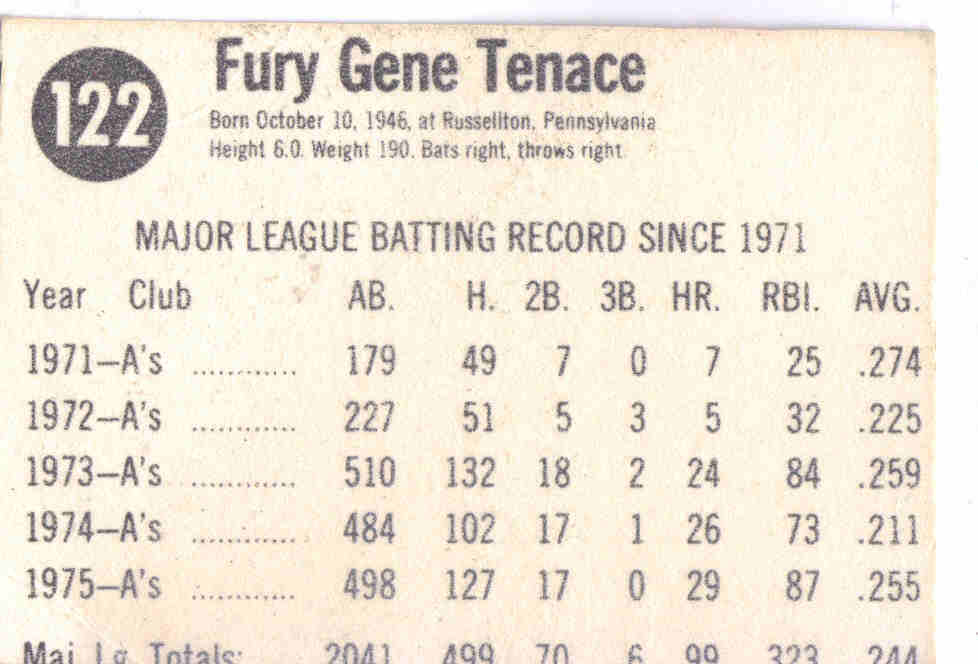
1976 Hostess #122 - Gene Tenace


  • As the card back shows, Gene Tenace was a part-time player until 1973. 
  • Tenace spent most of 1973 playing first base, then he was behind the plate for about 2/3 of the time in 1974. Gene played catcher for about 3/4 of his games in 1975.
  • Gene had some good power years from 1973-1975, averaging 26.3 home runs per season.
  • Tenace was an AL All Star in 1975 and also got a little bit of MVP support (18th in MVP voting)
  • Gene played in only 128 games in 1976. Tenace strained his left knee sliding into second base on April 20. It was thought that he would miss 10-14 days, but he ended up missing five weeks.
  • Tenace batted .249 with 22 HR and 66 RBI. It was the only year from 1973-1979 that he didn't walk over 100 times (he had 81 bases on balls)
  • After the 1976 season Tenace signed a six-year, $1.8 million contract with the San Diego Padres. He made $40,800 in 1976, so the pact represented a huge raise for Gene.
  • Before peak, peak, or after peak? after peak (barely)


Saturday, August 27, 2011

1976 Hostess #106 - George Foster


  • In the mid to late 1970s, getting any Cincinnati Reds player would have been great. They had a lot of great players!
  • After several years as an extra outfielder, George Foster had his "breakout" season in 1975.
  • George added to his success in 1976. 
  • Before peak, peak, or after peak? just before his peak --- 1977 was a monster year


Friday, August 26, 2011

1976 Hostess #100 - Bill Madlock


  • That is a nice looking lifetime batting average. The average would drop as the  years went by, but Bill Madlock still retired with a .305 average in a 15-year career
  • Bill had a great start to his career. He finished a distant third in NL Rookie of the Year voting in 1974,  but he avoided the sophomore jinx by winning the first of four NL batting titles in 1975.
  • Madlock had an eventful 1976 season. He made the headlines in early May when he took exception to  being hit by a pitch by San Francisco's Jim Barr. Barr had been warned by umpires earlier in the game after some inside pitches to Jose Cardenal. Madlock and Barr brawled and Madlock managed to land a right hook to Barr. Oddly, even after Barr had been warned, he was allowed to stay in the game while Madlock was ejected.
  • Bill was in contention for a second straight batting title in 1976, but he was quoted in August as saying his chances weren't very good because there were too many good hitters in the league.
  • On the last day of the season Ken Griffey was leading the batting race with a .338 average while Madlock had a .333 average. Griffey was not in the lineup for the final game. After Madlock went 4 for 4, Griffey was inserted into his game but struck out twice. Madlock won the title with a .339 average, three points ahead of Griffey's .336 average.
  • Before peak, peak, or after peak? peak


Thursday, August 25, 2011

1976 Hostess #93 - Bake McBride


  • Bake McBride was off to a fine start. He was the NL Rookie of the Year in 1974.
  • McBride was selected as a member of the 1976 NL All Star team. He didn't play in the game. 
  • Bake had an injury-riddled 1976 season. He missed three weeks in May with an injury and also missed  most of the first two weeks of July due to knee problems.
  • McBride had knee surgery in early August and missed the rest of the 1976 season.
  • Bake played in 72 games and batted .335 in 1976.
  • Before peak, peak or after peak? peak


Wednesday, August 24, 2011

1976 Hostess #61 - Bert Campaneris


  • Bert Campaneris was an AL All Star from 1972-1975.
  • Campaneris played out his option in 1976 in order to become a free agent after the season. Oakland owner Charlie Finley cut Bert's salary the maximum 20% (from $90,000 to $72,000).
  • In his final season with the A's, Campaneris batted .256 in 149 games and had a pukey .291 slugging percentage. He also stole 54 bases.
  • Bert signed a five-year, $950,000 contract with the Texas Rangers after the 1976 season.
  • After leaving Oakland, Campaneris had only one more full season (1977). He struggled offensively in 1978 and became a part-time player.
  • Before peak, peak, or after peak? after peak or very end of peak


Tuesday, August 23, 2011

1976 Hostess #30 - Reggie Smith


  • Reggie Smith was an All Star in three seasons (1972, 1974, 1975) during this five-year run
  • Smith led the AL in doubles and in total bases in 1972
  • Reggie got off to a slow start in 1976. In the first ten weeks of the season he was batting .281 with eight home runs in 47 games.
  • Smith was traded to the Los Angeles Dodgers for Joe Ferguson and two minor leaguers on June 15, 1976
  • Reggie was happy to go back to where he was born and raised.
  • Smith performed better in Los Angeles, batting .280 with ten home runs. He was out for three weeks with an injury in August.
  • Smith felt that baseball had made progress in hiring blacks in management positions, but he said that the sport had a ways to go.
  • After the 1976 season Reggie underwent left shoulder surgery. He bounced back to have two good years in 1977 and in 1978.
  • In mid-October 1976 Smith made news when his beaded necklace that had been stolen from Dodger Stadium turned up in the home of two Los Angeles youths who were selling stolen merchandise.
  • Before peak, peak, or after peak? peak (but 1976 was an off-year)


Monday, August 22, 2011

1976 Hostess #21 - Dave Rader


  • Dave Rader finished a distant second to Mets' pitcher Jon Matlack in NL Rookie of the Year voting in 1972
  • Dave was the regular Giants catcher from 1972-1974, then he platooned for the next two years
  • In 1976 Rader batted .263 in 88 games. He shared time behind the plate with Marc Hill and Mike Sadek.
  • After the 1976 season Dave was traded to the St. Louis Cardinals


Sunday, August 21, 2011

1976 Hostess #20 - Vida Blue


  • I just picked up a bunch of Hostess cards from eBay. They aren't in the best of condition, but they'll do for now. :)
  • Vida Blue was one of the best pitchers in baseball in the 1970s. His only bad years were 1972 and 1979. He also had a losing record in 1977, but a lot of that was due to the A's being decimated by trades and free agency.
  • Vida's first full season in the majors was a magical one. In 1971 he went 24-8 with a league-leading 1.82 ERA. Blue was the AL MVP and Cy Young Award winner that year.
  • Blue was an AL All Star in 1971 and in 1975. 
    • Vida was the winning pitcher in the 1971 All Star Game in spite of giving up three runs in three innings pitched. He gave up home runs to Hank Aaron and Johnny Bench
    • He started the 1975 All Star Game and gave up solo homers to Jimmy Wynn and Steve Garvey
  • Vida had another good (and also tumultuous) year in 1976. He had a record of 18-13 and a 2.35 ERA
  • Oakland owner Charlie Finley attempted to sell Blue to the New York Yankees in June. Commissioner Bowie Kuhn voided the sale because it was inconsistent with the best interests of baseball.
  • On August 28 Blue came within two outs of pitching a no-hitter against the Detroit Tigers. Mickey Stanley broke it up with a solo shot in the 9th inning.
  • The A's remained in the 1976 AL West chase until the last weekend of the season. On October 1, Blue pitched well against the California Angels but took the loss when Rusty Torres hit a home run in the 12th inning. The Oakland players were very upset with Finley after the game because of his lack of support for the club.
  • Finley offered to sell Blue to the Boston Red Sox after the 1976 season, but the Red Sox rejected the offer.