Showing posts with label Baltimore Orioles. Show all posts

Saturday, July 24, 2021

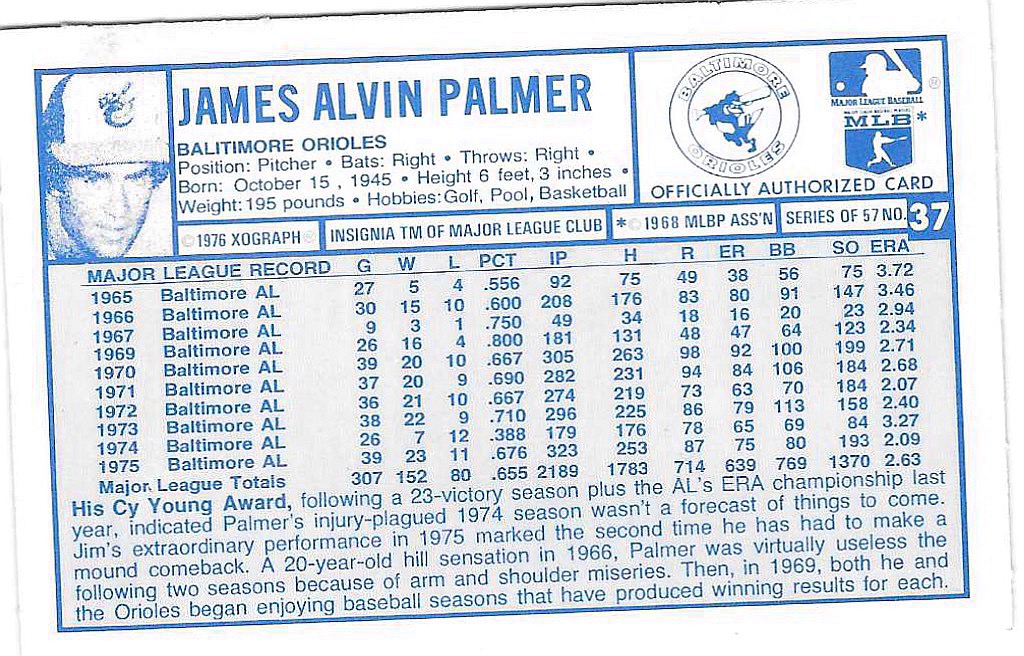
1976 Kellogg's #37 - Jim Palmer

 .


* What did he do to deserve a 1976 Kellogg's card?
    * Multiple Cy Young Award winner
    * Multiple 20 game winner
    * American League ERA leader
    * American League victories leader

* 1976 Highlights:
    * Won his third Cy Young award
    * Led the AL in victories for the second of three straight years

Twitter handle: @Jim22Palmer


Wednesday, July 13, 2011

1976 Hostess #121 - Mike Cuellar


  • This is a nice five-year run for Mike Cuellar. Two 20-win seasons and two others with 18 wins.
  • Mike was an important part of the Orioles' rotation from 1969-1975. He won the Cy Young Award in 1969.
  • Cuellar was out of gas by the time this card was printed. Mike was removed from the rotation in early June. He went 4-13 with a 4.96 ERA in 1976 and was waived after the season. 
  • Before peak, peak, or after peak? after peak


Saturday, July 2, 2011

1976 Hostess #56 - Jim Palmer


  • Those are some really nice looking stat lines
  • AL Cy Young Award winner in 1973 and in 1975
    • Jim also won the award in 1976
  • AL All Star in 1971, 1972, and 1975
  • AL ERA leader in 1973 and in 1975
  • Led the AL in victories in 1975 -- also led the league with 10 shutouts
  • Struggled with a sore arm in 1974 -- was placed on the disabled list on June 27 (retroactive to June 20) and didn't pitch until August 13.
  • Before peak, peak, or after peak? peak


Wednesday, June 29, 2011

1976 Hostess #36 - Brooks Robinson


Sunday, June 12, 2011

1976 Kellogg's #12 - Ken Singleton


  • What did he do to deserve a 1976 Kellogg's card?
    • In his first season in Baltimore Ken finished 10th in AL MVP voting
    • Singleton batted .300 with 15 HR and 118 walks in 1975
  • 1976 Highlights:
    • Batted .278 with 13 HR in 154 games
    • It was an "off year" compared to 1975 and 1977-1981.


Tuesday, December 7, 2010

1976 Topps #638 - Doyle Alexander


  • Doyle Alexander pitched for eight teams in a career that lasted from 1971 to 1989. Alexander was drafted by the Los Angeles Dodgers in 1968. After pitching in the minors for a few years Doyle came up to Los Angeles  in late June 1971.
  • Alexander was 6-6 with a 3.80 ERA in 17 games (12 starts) for the Dodgers in 1971. After the 1971 season Doyle was packaged with three other players in a trade to the Baltimore Orioles for Frank Robinson and Pete Richert.
  • Alexander pitched for the Orioles from 1972 until the middle of the 1976 season:
    • 1972 - 6-8, 2 saves, 2.45 ERA in 35 games (9 starts)
    • 1973 - 12-8, 3.86 ERA in 29 games (26 starts); started and lost game 5 of the ALCS
    • 1974 - 6-9, 4.01 ERA in 30 games (12 starts); pitched only three times after August 25
    • 1975 - 8-8, 3.04 ERA in 32 games (11 starts)
  • Doyle started the 1976 season with the Orioles (3-4, 3.50 ERA). Alexander was traded to the New York Yankees after it became apparent that he would leave as a free agent after the season. The trade proved to be a good one for the Orioles, as they got three players (Tippy Martinez, Rudy May, Rick Dempsey) who would be important parts of their 1979 AL Championship team. Alexander was 10-5 with a 3.29 ERA in 19 starts for the Yankees and helped them to the AL East title. Alexander wasn't used in the 1976 ALCS. He started and lost game 1 of the 1976 World Series.
  • After the 1976 season Alexander became a free agent and signed with the Texas Rangers for five years at $150,000 a year.
  • Doyle had a good year with the Rangers in 1977, going 17-11 with a 3.65 ERA in 35 starts. In 1978 Doyle was 9-10 with a 3.86 ERA in 28 starts.
  • Alexander missed five weeks of the 1979 season with an injury. He went 5-7 with a 4.45 ERA in 23 games (18 starts). 
  • After the 1979 season Doyle was traded to the Atlanta Braves. In 1980 Alexander was 14-11 with a 4.20 ERA in 35 starts for the Braves. After the 1980 season Alexander demanded to be traded and was traded to the San Francisco Giants for John Montefusco and a minor leaguer.
  • Alexander pitched well for the Giants in the 1981 strike season. He was 11-7 with a 2.89 ERA in 24 starts. After the 1981 season Alexander became a free agent and signed with the Yankees.
  • Doyle's 1982 season was a rough one. He missed two months of the season with an injury (he broke his finger after he slammed his fist into a dugout wall). Alexander went 1-7 with a 6.08 ERA in 16 games (11 starts) as he had trouble getting along with Yankee management all season.
  • Alexander started the 1983 season with the Yankees (0-2, 6.35 ERA) and was released on May 31. Doyle was picked up by the Toronto Blue Jays and went 7-6 with a 3.93 ERA in 15 starts.
  • Alexander led the AL with a .739 winning percentage in 1984. He had a 17-6 record with a 3.13 ERA in 1984.
  • Doyle had a nice season in 1985, going 17-10 with a 3.45 ERA in 36 starts.  Alexander started two games in the 1985 ALCS. He had no decision in game 3 and took the loss in game 6.
  • Alexander was on the move again in 1986. He started the season with the Blue Jays (5-4, 4.46 ERA in 17 starts) and was traded to the Braves for Duane Ward on July 6. Doyle went 6-6 with a 3.84 ERA in 17 starts for the Braves in 1986.
  • Doyle wasn't doing all that great for the Braves in 1987 (5-10, 4.13 ERA) but was involved in a classic "short-term vs. long-term" trade with the Detroit Tigers. The Tigers sent John Smoltz to the Braves in exchange for Alexander on August 12. Alexander was great for the Tigers, going 9-0 with a 1.53 ERA in 11 starts. The magic ran out in the ALCS as Doyle started and lost games 1 and 5 of the series.
  • Alexander was an AL All Star in 1988 but he didn't get into the game. Doyle was 14-11 with a 4.32 ERA in 34 starts for the Tigers in 1988.
  • In his last season Alexander had the misfortune of leading the league in losses. Doyle was 6-18 with a 4.44 ERA in 33 starts in 1989. Alexander wasn't offered a contract and retired after the 1989 season with a lifetime 194-174 record. His all-time post season record was 0-5 with an 8.38 ERA.

  • Liked to face: Ivan DeJesus (.000 in 16 AB); Curt Wilkerson (.063 in 16 AB); Jack Brohamer (.067 in 15 AB)
  • Hated to face: Tony Perez (.778 in 9 AB); Kelly Gruber (.558 in 18 AB); Johnny Bench (.500 in 20 AB)

.

Sunday, October 24, 2010

1976 Topps #594 - Rookie Catchers and Outfielders (Merchant, Ott, Stillman, White)


  • Andy Merchant
    • Drafted by the Boston Red Sox in 1972
    • Debuted in the majors at the end of the 1975 season
      • Played in one game (September 28) after the Red Sox clinched the AL East and went 2 for 4.
    • Appeared as a pinch hitter for the Red Sox twice in June 1976 and struck out both times. That was it for his major league career
    • Played in AAA in the Red Sox organization from 1974-1979
    • After his retirement from baseball he worked at Alabama Power as a line-clearing specialist from 1980-2000
    • Andy's SABR biography
  • Ed Ott
    • Drafted by the Pittsburgh Pirates in 1970
    • Played in the minors from 1970-1975
    • Had short stints with the Pirates in 1974 (0 for 5 in seven games) and in 1975 (1 for 5 in five games)
    • Played in 27 games in 1976 and batted .308 in 39 at bats
    • Split the catching duties with Duffy Dyer in 1977 --- batted .264 with 7 HR in 104 games
    • Slammed Mets 2B Felix Milan to the ground during an altercation on August 18, 1977. Milan was hurt and the injury basically ended his career.
    • Batted .269 with 9 HR in 112 games in 1978
    • Was the regular catcher for the Pirates in 1979 and  batted .273 with 7 HR and 51 RBI in 117 games
    • Played in three games in the 1979 NLCS and went 3 for 13 (.231)
    • Batted .333 (4 for 12) in three games in the 1979 World Series
    • Batted .260 with 8 HR and 41 RBI in 1980
    • Traded with Mickey Mahler to the California Angels for Jason Thompson after the 1980 season
    • Played in 75 games for the Angels in 1981 and batted .217
    • Did not play in 1982
    • Played in AAA in 1983 and retired after the season.
    • Coached with the Houston Astros from 1989-1993
    • Currently  manages the Sussex Skyhawks in the Canadian-American Association of Professional Baseball
    • Ed Ott reminisces
  • Royle Stillman
    • Drafted by the Los Angeles Dodgers in 1969
    • Played in the Dodgers' organization from 1969-1971 and then was traded to the Baltimore Orioles as part of the Frank Robinson deal
    • Played in AA in 1972 and then played all or parts of four seasons (1973-1976) for AAA Rochester
    • Played in 13 games for the Orioles in 1975 and went 6 for 14 (.429)
    • Played in 20 games in 1976 and went 2 for 22 (.091)
    • Became a free agent after the 1976 season and signed with the Chicago White Sox
    • Stayed with the White Sox for the entire 1977 season and batted .210 in 119 at bats
    • Cut by the White Sox at the end of spring training in 1978
    • Played for AAA Ogden and AAA Salt Lake City in the A's and Mariners organizations from 1978-1980
    • Held out in 1974. Stillman was one of Rochester's better players but was thought of as enigmatic by some teammates and people around the club
  • Jerry White
    • Drafted by the Montreal Expos in 1970 at the age of 17
    • Played in the minors from 1970-1974
    • Was called up in September 1974 and went 4 for 10 in nine games
    • Started the 1975 season in Montreal but was sent down to AAA in  late May
    • Came back to the Expos in September and ended up batting .299 in 39 games
    • Stayed in Montreal for the entire 1976 season and batted .245 in 114 games
    • Batted .190 in 16 games for Montreal in 1977 (was in AAA for most of the season)
    • Started the 1978 season in Montreal and was mostly used as a pinch runner (2 for 10 in 18 games)
    • Traded to the Chicago Cubs on June 23 for Woodie Fryman
    • Batted .272 in 59 games for the Cubs in 1978
    • Traded back to Montreal after the 1978 season with Rodney Scott for Sam Mejias
    • Batted .297 in 88 games for the Expos in 1979
    • Played in 110 games and batted .262 with 7 HR in 1980
    • Slumped to .218 in 59 games in 1981
    • Went 3 for 18 (.167) in the 1981 NLDS
    • Batted .313 (5 for 16) in the 1981 NLCS
    • Batted .243 in 69 games in 1982
    • Played in 40 games in 1983 and went 5 for 34 (.147). Also spent some time in AAA in 1983
    • Became a free agent after the 1983 season but was unsigned.
    • Played in Japan in 1984 and 1985
    • Signed by the St. Louis Cardinals before the 1986 season
    • Batted .125 (3 for 24) in 25 games in 1986 and was released on June 12
    • Has worked for the Minnesota Twins in various capacities since 1987 (except for two years in the mid-1990s when he worked for the Detroit Tigers)
    • Jerry has been the first base coach for the Twins since 1999.

Tuesday, October 19, 2010

1976 Topps #589 - Rookie Pitchers (Alcala, Flanagan, Pactwa, Torrealba)


  • I didn't care for these four-player rookie cards when I was a kid:
    • I couldn't file the cards under a particular team
    • The cards didn't have very much information about the players
    • I cared more about getting players I had heard of instead of rookies
    • The only rookies I heard of were the ones who played with or against the Phoenix Giants in the Pacific Coast League.
  • Santo Alcala
    • Signed by the Cincinnati Reds in 1970
    • Pitched for the Reds (1976, 1977) and the Montreal Expos (1977)
    • 11-4, 3.70 ERA in 30 games (21 starts) in 1976 -- did not pitch in the postseason
    • Started the 1977 season 1-1 with a 5.74 ERA in seven games (two starts) for the Reds
    • Traded to the Montreal Expos on May 21 for Shane Rawley and Angel Torres
    • Was 2-6 with two saves and had a 4.69 ERA in 31 games (10 starts) for the Expos in 1977
    • Waived to the Seattle Mariners before the 1978 season
    • Pitched in the Seattle organization in 1978 and in the Pittsburgh Pirates organization from 1979-1982 but never got back to the majors.
  • Mike Flanagan
    • Mike was by far the most successful player on this card.
    • Drafted in 1973 by the Baltimore Orioles
    • Started pitching for the Orioles in September 1975 (0-1, 2.79 ERA in two games)
    • 1976 - split the season between Baltimore (3-5, 4.13 ERA) and AAA Rochester.
    • 1977 - 15-10, 3.64 ERA
    • 1978 - 19-15, 4.03 ERA; led AL with 40 starts; AL All Star (didn't get in game)
    • 1979 - 23-9, 3.08 ERA; led AL in wins; AL Cy Young Award winner; 1-0 in ALCS, 1-1 in World Series
    • 1980 - 16-13, 4.12 ERA
    • 1981 - 4-6, 4.19 ERA
    • 1982 - 15-11, 3.97 ERA
    • 1983 - 12-4, 3.30 ERA; missed 10 weeks of the season with a knee injury; 1-0 in ALCS, 0-0 in one start in World Series
    • 1984 - 13-13, 3.53 ERA
    • 1985 - 4-5, 5.13 ERA; didn't pitch until July 20 due to a torn achilles tendon
    • 1986 - 7-11, 4.24 ERA
    • 1987 - 3-6, 4.94 ERA with Orioles; traded to Toronto Blue Jays on August 31; 3-2, 2.37 ERA with Blue Jays
    • 1988 - 13-13, 4.18 ERA
    • 1989 - 8-10, 3.93 ERA; started and lost game 4 of ALCS
    • 1990 - 2-2, 5.31 ERA in five starts; last game was May 4; released by Blue Jays on May 8
    • 1991 - Tried out with Orioles in spring training and made the ballclub; 2-7, 3 saves, 2.38 ERA in 64 games (1 start)
    • 1992 - 0-0, 8.05 ERA in 42 games; retired after the season
    • Has been a pitching coach, a front office executive, and a broadcaster with the Orioles since his playing career ended.
    • Mike Flanagan: A Career That Almost Wasn't - January 1980 Baseball Digest
  • Joe Pactwa
    • Drafted by the New York Yankees in 1966
    • Pitched in the Yankees organization from 1966-1974 without making it to the majors
    • Originally an outfielder but started pitching in 1973.
    • Spent most of the 1975 season in the Mexican League and purchased by the California Angels on September 12.
    • Pitched for the Angels at the end of the 1975 season and went 1-0 with a 3.86 ERA in four games (three starts)
    • Played in Mexico from 1976-1982.
    • Passed away at the age of 60 on March 10, 2009
  • Pablo Torrealba
    • Signed by the Atlanta Braves in 1966
    • Pitched in the minors from 1966-1971
    • Did  not pitch in 1972 and then returned to the Braves organization in 1973 and pitched in the minors from 1973-1975.
    • Started the 1975 season with the Braves and went 0-1 with a 1.35 ERA in six games before being sent down to AAA Richmond
    • Spent the entire 1976 season with the Braves and went 0-2 with two saves and had a 3.57 ERA in 36 games
    • Sold to the Oakland A's during spring training in 1977
    • Went 4-6 with two saves and had a 2.62 ERA in 41 games (10 starts) in 1977.
    • Traded to the Chicago White Sox during spring training in 1978 for Jim Essian and Steve Renko
    • Had a 2-4 record with one save and a 4.71 ERA in 25 games (three starts) in 1978
    • Started the 1979 season with the White Sox (0-0, 1.59 ERA in three games) but was sent down in late April and spent the majority of the season with AAA Iowa. Pablo had a 6.95 ERA for Iowa in 1979, which was  his last season.
    • Pablo is now the scouting coordinator in Venezuela for the Houston Astros.

.

Tuesday, September 14, 2010

1976 Topps #555 - Dyar Miller


  • Dyar Miller pitched for four teams from 1975-1981. Miller was signed by the Philadelphia Phillies on July 7, 1968. Miller was released three weeks later and subsequently signed with the Baltimore Orioles. 
  • Dyar pitched in the Baltimore system from 1969-1975 but was stuck behind a lot of other good pitchers in the organization. Miller finally came up to the Orioles in 1975 at the age of 29 and pitched in 30 games. Dyar was 6-3 with eight saves and had a 2.72 ERA in 1975.
  • Miller had another good year as a reliever in 1976. He was 2-4 with seven saves and had an ERA of 2.94 in 49 games.
  • In 1977 Miller started with the Orioles and was 2-2 with a 5.64 ERA in 12 games. Dyar was traded to the California Angels for Dick Drago on June 13. Miller went 4-4 with a 3.02 ERA in 41 games for the Angels in '77.
  • Dyar went 6-2 with a 2.66 ERA in 41 games for the Angels in 1978. Miller started the 1979 season with the Angels (1-0, 3.31 ERA in 14 games) and was sold to the Toronto Blue Jays on June 6. Dyar pitched in ten games for the Blue Jays and had an ERA of 10.57. He didn't pitch after July 22. After the 1979 season Miller was traded to the Montreal Expos for Tony Solaita.
  • Miller was released by the Expos during spring training in 1980. He signed with the New York Mets in April and had a good year. Dyar went 1-2 with a 1.93 ERA in 31 games in 1980. Miller went 1-0 with a 3.29 ERA in 23 games in 1981. The Mets released Miller after the 1981 season and he retired.
  • After his playing career Miller coached and occasionally managed in the minors. Dyar was a member of the Chicago White Sox coaching staff in 1987 and 1988. He has worked in the St. Louis Cardinals organization since 1995 and is currently the pitching coach for the AAA Memphis Redbirds.
  • Liked to face: Ralph Garr (.067 in 15 AB); Gorman Thomas/Lamar Johnson (.083 in 12 AB)
  • Hated to face: Thurman Munson (.692 in 13 AB); Bruce Bochte (.600 in 10 AB); Dan Ford (.500 in 14 AB)

.

Friday, August 27, 2010

1976 Topps #537 - Tony Muser


  • Tony Muser was a major leaguer in 1969 and from 1971-1978. He was mostly a first baseman but also saw some playing time at third base and in the outfield. Muser was signed by the Boston Red Sox in 1967. Tony played in the  minors from 1967-1969. Muser had a small taste of the majors in 1969 when the Red Sox called him up in September. Tony played in two games and went 1 for 9 (.111).
  • Muser spent the 1970 season in the minors -- he played for Cincinnati's AAA Indianapolis club on a loan arrangement. During spring training in 1971 Tony was traded with Vincente Romo to the Chicago White Sox for Duane Josephson and Danny  Murphy. Muser spent most of the 1971 season in the minors and batted .313 in 11 games for Chicago.
  • Tony started the 1972 season in the minors and was called up in early July. Muser was used mostly as a pinch hitter and defensive replacement and batted .279 in 61 at bats.
  • Muser became the starting first baseman in late June of 1973 after an injury to Dick Allen. Tony batted .285 in 106 games but he hit only four home runs and the White Sox really missed Allen's power.
  • Muser returned to a backup role in 1974. Tony played in 103 games and batted .291 in 206 at bats. In 1975 Tony started with the White Sox (.243 in 43 games) and was traded to the Baltimore Orioles on June 15 for Jesse Jefferson. Muser was used mainly as a defensive replacement and batted .317 in 82 at bats for the Orioles to finish the 1975 season.
  • Tony was a backup first baseman and defensive replacement for Lee May in 1976. Tony also played at 1B most of the time when May was used at DH. Muser played in 136 games and batted .227 in 336 at bats. In 1977 Muser backed up at 1B again and played in 120 games. He batted .229 in 118 at bats.
  • Muser was released before the 1978 season. He signed with the Milwaukee Brewers and spent the first three months of the season playing for AAA Spokane. Tony was brought up to the Brewers in July and batted .133 in 15 games. Muser retired from major league baseball with a total of seven lifetime home runs.
  • Tony played in Japan in 1979. He came back to the Brewers organization in 1980 and managed in their farm system through the 1984 season. Muser coached for the Brewers from 1985-1989. He went back to manage Milwaukee's AAA Denver club in 1991 and 1992.
  • Muser was the hitting coach for the Chicago Cubs from 1993-1997. Tony became the manager of the Kansas City Royals on July 9, 1997 and managed the team until he was fired early in the 2002 season.
  • Tony was a coach with the San Diego Padres from 2003-2006. He managed a rookie league team for the Padres in 2007 and he is now a roving minor league instructor.
  • Liked to face: Steve Hargan (.500 in 14 AB); Jim Palmer (.467 in 15 AB); Doyle Alexander (.389 in 18 AB)
  • Hated to face: Jim Kern (.000 in 12 AB); Vern Ruhle (.071 in 14 AB); Bill Singer (.095 in 21 AB)

.

Sunday, July 25, 2010

1976 Topps #505 - Mark Belanger

.
  • Mark Belanger was the epitome of the "good field/no hit" shortstop. Belanger won eight Gold Gloves (1969, 1971, 1973-1978) but hit above .230 in only three of his full seasons. Belanger was signed by the Baltimore Orioles in 1962 and played in the minors in 1962 and in 1964. Mark was in the Army in 1963 and didn't play.
  • Mark first came up to the Orioles in 1965. He played in 11 games (1 for 3) in 1965 and eight games (3 for 19) in 1966. Belanger was Luis Aparicio's backup in 1967 and took over the full-time shortstop job when Aparicio was traded after the 1967 season.
  • Belanger had his best season in 1969 when he won his first Gold Glove and batted .287 in 150 games. He hit the first home run in ALCS history in 1969, which was interesting since he hit only 20 home runs in his entire career.  Mark (The Glove) Belanger Adds Another Dimension- November 1969 Baseball Digest
  • Mark became the "triple crown loser" in 1970 by finishing last in the AL in all three triple crown categories (.218, 1 HR, 36 RBI). 
  • Belanger's biggest offensive seasons were in 1971 (.266 with a .365 OBP) and 1976 (.270 with 27 stolen bases). Mark made the AL All Star team in 1976 and went 0 for 1. Mark Belanger - The Orioles' Mechanical Man on Defense - December 1971 Baseball Digest. Mark Belanger: The Run Saver - August 1974 Baseball Digest.
  • Belanger was the starting shortstop for the Orioles from 1968-1978. Mark Belanger: The Orioles' 'Mr. Glove' - June 1978 Baseball Digest.Mark was supplanted as the starter by Kiko Garcia in 1979 and although he played in 101 games he batted only .167 in 198 AB.
  • Mark regained his starting position in 1980 and was also the starter in 1981. Belanger batted .165 in 64 games in 1981 and was allowed to leave as a free agent after the season (the Orioles had Cal Ripken Jr. ready for the majors). Mark was one of four players who led negotiations for the Players Association during the 1981 strike.
  • Belanger signed with the Los Angeles Dodgers for the 1982 season and batted .240 in 50 at bats. Mark retired after he was released by the Dodgers following the 1982 season.
  • After his retirement Mark worked for the Players Association as a liason between the players and the union leadership.
  • Belanger died of lung cancer on October 6, 1998.
  • Liked to face: Jim Kern (.625 in 16 AB); Dave  Morehead (.533 in 15 AB); Fritz Peterson (.308 in 78 AB)
  • Hated to face: Rick Waits (.000 in 17 AB); Al Fitzmorris (.040 in 25 AB); Gaylord Perry (.083 in 48 AB)

Wednesday, June 23, 2010

1976 Topps #473 - Paul Blair


  • Paul "Motormouth" Blair was a great defensive center fielder who spent most of his career with the Baltimore Orioles. Blair was signed by the New York Mets in 1961 and, after spending 1962 playing in the Mets' system, was drafted by the Orioles in the "first year draft." Paul played in the Orioles' system in 1963 and 1964 and was 0 for 1 for the Orioles in a short call-up in late 1964.
  • Blair was given the starting center field job for the Orioles in 1965. He struggled at the plate and was sent down for a month in July. Blair batted .234 in 119 games for the Orioles in '65. Paul improved his offense in 1966 and batted .277 in 133 games. He went 1 for 6 in the World Series.
  • Paul won the first of eight Gold Glove awards in 1967. He also had a good year at the plate as he led the AL with 12 triples and batted .293 with 11 home runs. Blair batted .211 in 141 games in 1968.
  • Blair won a Gold Glove in 1969 and would win the award every season from 1969-1975. Paul also made the AL All Star team for the first time and went 0 for 2 in the game. Blair batted .285 with a career-high 26 home runs and scored 102 runs. Paul batted .400 in the ALCS and .100 in the World Series.
  • Paul was beaned by a pitch by Ken Tatum on May 31, 1970 and suffered a  broken nose. His offense suffered due to the beaning and he was never the same hitter. Blair batted .267 with 18 HR in 133 games in 1970 and batted .077 in the ALCS and .474 in the World Series.
  • Blair tried to become a switch-hitter in 1971 but the experiment ended after he went 11 for 57 (.193). Paul batted .262 with 10 HR in 141 games in 1971. Blair batted .333 in the ALCS  and .333 in the World Series.
  • Paul had a down year offensively in 1972, batting .233 in 142 games. In 1973 he came back to be an AL All Star again (he was a late-inning defensive replacement). Blair batted .280 with 10 HR and 64 RBI in '73 and batted .167 in the ALCS.
  • Blair got some minor MVP consideration in 1974 (13th place) and batted .261 with 17 HR and 62 RBI. He batted .286 in the ALCS. It would be his last productive offensive year. In 1975 he won his last Gold Glove but batted .218 in 140 games. Paul dropped to .197 in 146 games in 1976. After the 1976 season Blair asked to be traded (he didn't agree with being platooned in centerfield) and was traded to the New York Yankees for Elliot Maddox and Rick Bladt.
  • The Yankees of the late 1970s were loaded and Blair became a backup outfielder. In 1977 Paul batted .262 in 164 at bats while playing in 83 games. He went 2 for 5 in the ALCS and 1 for 4 in the  World Series. Blair batted .176 in 125 at bats in 1978. He was 0 for 6 in the ALCS and batted .375 in the World Series.
  • Paul played in two games for the Yankees in 1979 (1 for 5) and then was released on April 12. Blair was signed by the Cincinnati Reds on  May 8 but he batted only .150 in 140 at bats. Paul retired after the season and became a coach in the Yankees organization.
  • The Yankees needed some outfield help in 1980 so Blair was activated for about a month. He played in 12 games but batted only twice (0 for 2). After his release on July 1 Blair went back to coaching.
  • In 1982 Paul was hired as the coach for Fordham University. He coached there for the 1982 season and then did some coaching in the Houston Astros and the Orioles' organizations. He then played in the Senior Professional Baseball League and became the manager of an independent team. Paul coached for Coppin State College from 1998-2002. Blair had a heart attack in 2009 and is now recovered and retired in Maryland.
  • An Ex-Star Speaks Out Against Platooning System - September 1988 Baseball Digest
  • Centerfielder Paul Blair: He Was A Gifted Ball Hawk - June 1992 Baseball Digest
  • Liked to face: Steve Barber (.480 in 25 AB); Paul Splittorff (.441 in 34 AB); Gary Bell/Juan Pizarro (.417 in 24 AB)
  • Hated to face: Jesse Jefferson (.000 in 15 AB); Andy  Messersmith (.083 in 24 AB); John O'Donohuge (.100 in 20 AB)

Thursday, May 27, 2010

1976 Topps #450 - Jim Palmer


  • A Jim Palmer was a great pack pull in the 1970s. He won 20 or more games eight out of ten years in the 1970s. Jim won three AL Cy Young Awards and finished second in two other seasons. Palmer pitched for the Baltimore Orioles from 1965-1984 and was elected to the Hall of Fame in 1990.

  • Palmer was signed by the Baltimore Orioles in 1963. Palmer's career almost ended before it started when he was involved in an automobile accident near Kayenta, AZ (on the Navajo reservation) on August 16, 1963 (May 1990 Baseball Digest). He was 11-3 with a 2.51 ERA for Class A Aberdeen in 1964 and that earned him a shot at the Orioles in 1965. Jim was a swingman in 1965 and was 5-4 with a 3.72 ERA in 27 games (6 starts).

  • Jim became a regular member of the Baltimore rotation in 1966. He started 30 games and was 15-10 with a 3.46 ERA. Palmer started game 2 of the 1966 World Series and beat Sandy Koufax by pitching a 4-hit shutout.

  • In 1967 Jim started with the Orioles but was injured and missed several months of the season. He ended up 3-1 with a 2.94 ERA in nine starts. Palmer didn't pitch for the Orioles at all in 1968 but he did do some pitching in the minors. He felt some muscles ripping in his back one day in 1968 while pitching in the minors and went back to Baltimore for some tests. Jim had surgery, went on a weight program and was able to rehabilitate himself.

  • Palmer came back in 1969 to lead the AL with a .800 winning percentage. Jim was 16-4 with a 2.34 ERA in 23 starts. He had a shot at winning 20 games but he was injured (unrelated to his arm) and missed six weeks. Jim pitched a no-hitter against the Oakland Athletics on August 13. Palmer started and won game 3 of the ALCS. He took the loss in game 3 of the World Series.

  • Jim made his first AL All Star team in 1970. He started the game and pitched three scoreless innings. Palmer went 20-10 with a 2.71 ERA and led the AL with five shutouts and 305 innings pitched. Palmer won game 3 of the ALCS. He started twice in the World Series and was the winning pitcher in game 1.

  • Palmer pitched two scoreless innings in the 1971 All Star Game. He was 20-9 with a 2.68 ERA, won game 3 of the ALCS, and won game 2 of the World Series. He started game 6 of the World Series and left the game after nine innings with the score tied 2-2 (Baltimore won the game in 10 innings).

  • Jim went 21-10 with a 2.07 ERA in 1972. He started the All Star Game and pitched three scoreless innings. In 1973 Palmer won his first AL Cy Young Award and finished second to Reggie Jackson in MVP voting. Jim went 22-9 with a league-leading 2.40 ERA. In the 1973 ALCS Palmer pitched a 5-hit shutout in game 1. He started game 4 but got knocked out in the second inning after allowing three runs. Jim entered game 5 in the fourth inning and shut the A's out over 4 1/3 innings but the damage was done as Oakand won the game and the series. A side note: it's hard to believe that only 24,265 fans attended that deciding game in Oakland. Jim Palmer Views The Pinch Hitting Rule - May 1973 Baseball Digest.

  • Palmer missed two months of the 1974 season with elbow problems. He went 7-12 and had a 3.27 ERA in 26 starts. Jim started game 3 of the ALCS and allowed only one run (a Sal Bando solo home run) on four hits in nine innings, but Vida Blue pitched a shutout and Palmer was tagged with his only career League Championship Series loss.

  • Jim came back to pitch very well in the next three seasons. He led the AL in wins in 1975, 1976, and 1977. Palmer won the AL Cy Young Award in '75 and '76 and was the runner up in 1977. Palmer was 23-11 with an AL-leading 2.09 ERA in 1975. In 1976 he was 22-13 with a 2.51 ERA. Jim Palmer: The Orioles' Pitching Symphony - January 1977 Baseball Digest. Jim went 20-11 with a 2.91 ERA in 1977. Palmer also won four straight Gold Gloves from 1976-1979. How Jim Palmer Sizes up His Pitching - June 1977 Baseball Digest.

  • Jim didn't lead the AL in wins in 1978 (Ron Guidry had his great 25-win season that year) but still pitched well. He was 21-12 with a 2.46 ERA and was third in Cy Young Award voting. Palmer was hurt in 1979 and missed six weeks from early July to mid August. He ended up 10-6 with a 3.30 ERA in 23 starts. Jim started game 1 of the ALCS and left the game after nine innings with the score tied 3-3. The Orioles won that game in ten innings. He started game 2 (no decision) and game 6 (a loss) of the 1979 World Series.

  • Palmer's ERA shot up to 3.98 in 1980 but he still had a good 16-10 record in 33 starts. Jim was 7-8 with a 3.75 ERA in 22 starts in 1981.

  • Jim's last big year was 1982. He went 15-5 and led the AL with a .750 winning percentage. Palmer finished second to Pete Vuckovich in AL Cy Young Award balloting during a year in which nobody would win more than 18 games.

  • Jim made two trips to the disabled list in 1983, missing a total of about 3 1/2 months. He was 5-4 with a 4.23 ERA in 11 starts in 1983. Palmer wasn't used in the 1983 ALCS, but he pitched two innings in relief in game 3 of the World Series and earned the win.

  • Palmer's last year was 1984. He was 0-3 with a 9.17 ERA when he was released on May 12, 1984.
    News story about Palmer's release:

  • After his playing career Palmer became a broadcaster. He was already doing postseason games for ABC during seasons when the Orioles weren't in the playoffs. Jim is now broadcasting for the Orioles.

  • Jim attempted a comeback in 1991, a year after he was elected to the Hall of Fame. The comeback lasted for a few weeks in spring training.

  • Jim seems to be the calm one out of the three pitchers interviewed for this article about baseball's unwritten rules.


  • Liked to face: Barry Bonnell (.000 in 15 AB); Jamie Quirk (.045 in 22 AB); John Ellis (.056 in 36 AB)

  • Hated to face: Al Oliver (.478 in 23 AB); Rickey Henderson (.476 in 21 AB); Rod Carew (.358 in 95 AB)

Thursday, May 13, 2010

1976 Topps #438 - Doug DeCinces

  • Doug DeCinces had the not-so-enviable task of replacing the legendary Brooks Robinson at third base for the Baltimore Orioles. DeCinces was drafted by the Orioles in 1970. Doug had plenty of time to develop in the minors. He had short stints with the Orioles in 1973 (.111 in 18 AB) and in 1974 (.000 in 1 AB).


  • DeCinces came to the majors to stay in 1975. He was used as a utility infielder in ’75 and batted .251 in 167 at bats. Doug was a utility guy again at the beginning of the 1976 season and took over at third base in the middle of the year. He batted .234 with 11 HR in 129 games.


  • DeCinces got to the playoffs with Baltimore in 1979. He batted .230 with 16 HR and 60 RBI during the regular season. He batted .308 during the ALCS and .200 during the World Series. Doug DeCinces – The Game I’ll Never Forget – September 1987 Baseball Digest.


  • Doug spent two more seasons with the Orioles. He batted .249 with 16 HR and 64 RBI in 1980 and .263 with 13 HR and 55 RBI in 1981. After the 1981 season the Orioles needed to make room for Cal Ripken Jr. DeCinces was traded to the California Angels with Jeff Schneider for Dan Ford.


  • DeCinces had his best season as a major leaguer in 1982. He finished 3rd in MVP voting and won the AL Silver Slugger award at third base. Doug batted .301 with 30 HR and 97 RBI for the Angels in 1982. He batted .316 in the ALCS.


  • Doug made the AL All Star team in 1983 (he was 0 for 1 as a pinch hitter) and batted .281 with 18 HR and 65 RBI in 95 games. Doug was injured and missed two months of the 1983 season (late June-late August).


  • In 1984 DeCinces batted .269 with 20 HR and 82 RBI. He batted .244 with 20 HR and 78 RBI in 1985. Doug finished 11th in MVP voting in 1986 as he batted .256 with 26 HR and 96 RBI and helped the Angels to the AL West title. He batted .281 in the 1986 ALCS.


  • Doug’s last major league season was 1987. He batted .234 with 16 HR and 64 RBI for the Angels. DeCinces was released by the Angels in late September and signed with the St. Louis Cardinals. He batted .222 (2 for 9) with the Cardinals in four games and retired after the season. Doug played one season (1988) in Japan.


  • Liked to face: Jerry Augustine (.486 in 37 AB); Mike Moore (.452 with 6 HR in 42 AB); Mike Flanagan (.444 in 27 AB)

  • Hated to face: Dave J. Schmidt (.000 in 14 AB); Don Aase (.050 in 20 AB); Dave Stewart (.074 in 27 AB)

Saturday, April 17, 2010

1976 Topps #414 - Wayne Garland

  • Wayne Garland pitched in the majors from 1973-1981. He was one of the first pitchers to get a big contract after becoming a free agent. Garland was drafted by the Baltimore Orioles in 1969. He pitched in the minors from 1969-1974. Garland had a hard time breaking into the Baltimore pitching staff. Wayne had a great season in AA in 1971 (19-5 with a 1.71 ERA) but still spent three more season in AAA Rochester before getting to the majors to stay.

  • Garland had a short stint in the majors in 1973 (0-1, 3.94 ERA in 4 games). He split the 1974 season between Rochester and the Orioles. Wayne was 5-5 with a 2.97 ERA in 20 games (6 starts) in 1974. He pitched 2/3 of an inning for the Orioles in the 1974 ALCS. In 1975 Wayne was mostly a reliever -- he pitched in 29 games (including 1 start) and was 2-5 with 4 saves and a 3.71 ERA.

  • Garland's big season was in 1976. He was 20-7 with a 2.67 ERA in 38 games (25 starts). He didn't join the rotation until mid-June. The Orioles tried hard to get Wayne his 20th win. In his last start on September 28 Wayne pitched 11 innings before getting the win. After the 1976 season Garland became a free agent and signed a 10-year, $2.3 million contract with the Cleveland Indians.

  • Garland started 38 games for the Indians in 1977 and led the AL with 19 losses. He was 13-19 with a 3.60 ERA in '77. He had torn his rotator cuff during spring training in '77 and tried to pitch through the injury. Wayne had rotator cuff surgery in 1978 and made only six starts (2-3, 7.89 ERA). In 1979 Wayne was a member of the rotation through June and then went on the DL for two months before rejoining the Indians in late August. Garland went 4-10 with a 5.23 ERA in 18 games (14 starts) in '79.

  • Wayne pitched in 25 games (20 starts) in 1980 and went 6-9 with a 4.61 ERA. Garland was 3-7 with a 5.79 ERA in 12 games in 1981. He was released after the 1981 season.

  • Garland made six starts for AA Nashville (New York Yankees organization) but was 1-3 with a 7.48 ERA.

  • After his playing career Wayne became a minor league pitching coach. He also managed the minor league Nashville Sounds for three games in 1988.

  • Here is a chapter about Garland in Our Tribe: A Baseball Memoir by Terry Pluto. Here is a chapter from Tales from the Tribe Dugout by Russell Schneider.

  • Liked to face: Lou Piniella (.000 in 17 AB); Jorge Orta (.083 in 24 AB); Bucky Dent (.115 in 26 AB)
  • Hated to face: Jeff Newman (.722 in 18 AB); Jerry Remy (.500 in 30 AB); Rick Miller (.441 in 34 AB)


Thursday, March 25, 2010

1976 Topps #393 - Paul Mitchell


  • Paul Mitchell pitched in the majors from 1975-1980. Mitchell was drafted by the Pittsburgh Pirates in 1968 but didn't sign. He was then drafted by the Baltimore Orioles in 1971. Paul pitched in the minors from 1972-1975, mostly for their AAA Rochester team.

  • Mitchell was 10-1 with a 2.06 ERA in 14 starts for Rochester in 1975 when he was called up to the Orioles in late June. He pitched in 11 games (4 starts) for the Orioles in 1975 and was 3-0 with a 3.63 ERA. After the 1975 season Paul was traded with Mike Torrez and Don Baylor to the Oakland A's for Reggie Jackson, Ken Holtzman and a minor leaguer.

  • Paul was 9-7 with a 4.25 ERA in 26 starts for the A's in 1976. In 1977 Mitchell had a rough go of it with the A's. He pitched in five games (3 of them starts) and was 0-3 with a 10.54 ERA. Paul spent some time in the minors and didn't fare very well either. On August 4 Mitchell was purchased by the Seattle Mariners. He was inserted into Seattle's starting rotation and was 3-3 with a 4.99 ERA in nine starts.

  • Mitchell was 8-14 with a 4.18 ERA in 29 starts for the Mariners in 1978. Paul started the 1979 season with the Mariners and was 1-4 with a 4.42 ERA in 10 games (6 starts) when he was traded to the Milwaukee Brewers on June 7 for Randy Stein. Paul pitched in 18 games (8 of them starts) for the Brewers in '79 and was 3-3 with a 5.76 ERA.

  • Paul was an occasional starter and reliever for the Brewers in 1980. He went 5-5 with one save and a 3.53 ERA in 17 games (11 starts). He also spent about 7 weeks pitching for AAA Vancouver in 1980.

  • At the end of spring training in 1981 Mitchell was released by the Brewers. He hooked on with the New York Yankees' AAA Columbus team and pitched in seven games but Paul didn't make it back to the majors.

  • Liked to face: Kevin Bell (.000 in 13 AB); Reggie Jackson (.136 in 22 AB); Rusty Staub (.118 in 17 AB)
  • Hated to face: Rod Carew/Larry Hisle (.563 in 16 AB); Roy Smalley (.483 in 29 AB); Mike Hargrove (.480 in 25 AB)

Wednesday, March 3, 2010

1976 Topps #371 - Ellie Hendricks


  • Ellie Hendricks was from the Virgin Islands and was signed by the Milwaukee Braves in 1959. He spent the 1959 and 1960 seasons playing for D league teams and then didn't play in 1961. Ellie moved to the St. Louis Cardinals organization in 1962 and played in their system in 1962 and 1963. Hendricks played in the Mexican League in 1964 and then didn't play in organized ball in 1965. He then bounced between AA, AAA, and the Mexican League in 1966 and 1967.

  • The Baltimore Orioles drafed Hendricks in the Rule 5 draft after the 1967 season. Ellie finally got to play in the majors in 1968 at the age of 27. He batted .202 in 79 games. In 1969 Hendricks split time with Andy Etchebarren behind the plate. He batted .244 with 11 HR in 105 games. Ellie batted .250 in the ALCS but was only 1 for 10 in the World Series.

  • Hendricks had a similar year in 1970. He batted .242 with 12 HR and 41 RBI in 106 games. Ellie was 2 for 5 in the ALCS and batted .364 (4 for 11) in the World Series. He was involved in a strange play at the plate in game 1 of the Series. Ty Cline hit a high chopper in front of the plate. Ellie grabbed the ball with his bare hand and attempted to tag out Bernie Carbo, who was trying to score from third. Ellie tagged Carbo with his glove hand while the ball was still in his bare hand. The umpire was shielded from the play and called Carbo out. The Reds argued, but to no avail. Replays later showed that Carbo missed the plate while avoiding the tag.

  • Ellie was a platoon catcher again in 1971. He batted .250 with 9 HR and 42 RBI in 101 games. He was 2 for 4 in the ALCS and batted .263 (5 for 19) in the World Series. Hendricks started the 1972 season with the Orioles (.155 in 33 games) but was traded to the Chicago Cubs for Tommy Davis on August 18. He finished the 1972 season with the Cubs (.116 in 17 games) and then was traded back to the Orioles for Frank Estrada.

  • Hendricks was a third catcher for the Orioles from 1973-1975. In 1973 he batted .178 in 41 games. Ellie batted .208 in 66 games in 1974 and was 1 for 6 in the ALCS. In 1975 Hendricks batted .215 in 85 games.

  • Ellie started the 1976 season with the Orioles and was batting .139 in 28 games when he was traded to the New York Yankees in a huge trade. The Orioles traded Ellie with Doyle Alexander, Jimmy Freeman, Ken Holtzman and Grant Jackson to the Yankees for Rick Dempsey, Tippy Martinez, Rudy May, Scott McGregor and Dave Pagan. Hendricks batted .226 in 26 games for the Yankees to finish the 1976 season and then was 1 for 1 in the ALCS and 0 for 2 in the World Series.

  • Hendricks spent most of the 1977 season playing for New York's AAA Syracuse club. He was 3 for 11 in 10 games for the Yankees and became a free agent after the season.

  • Hendricks became Baltimore's bullpen coach in 1978 and was a player-coach in 1978 and 1979. Ellie batted 21 times (6 for 18 with 3 walks) in 12 games in 1978. He even pitched 2 1/3 innings in a game, allowing a hit and a walk but no runs. In 1979 Hendricks was 0 for 1.

  • After he stopped playing he continued as Baltimore's bullpen coach until the end of the 2005 season. His contract wasn't renewed after '05 in part due to a stroke he suffered in April 2005. It was the longest tenure (28 years) any Oriole coach ever had. Hendricks was going to be reassigned with in the Baltimore Organization for the 2006 season. Ellie died of a heart attack in December 2005 one day before his 65th birthday. He was a very popular Oriole.

  • Here is a SABR biography of Hendricks.

  • Liked to face: Jim Perry (.448 in 25 AB); Marty Pattin (.357 with 4 HR in 28 AB); Jim Slaton (.348 in 23 AB)
  • Hated to face: Bert Blyleven (.000 in 23 AB); Andy Messersmith/Steve Kline (.100 in 20 AB)

Tuesday, January 26, 2010

1976 Topps #335 - Bob Grich


  • Bobby Grich was drafted in the first round by the Baltimore Orioles in 1967. He played in the minors from 1967-1970 and was brought up to the Orioles in late June of 1970 after batting .383 in 63 games with AAA Rochester. He batted .211 in 30 games for the Orioles and didn't play in the postseason.
  • Grich spent the 1971 season in Rochester and batted .336. He batted .300 in 7 September games for the Orioles. Bobby was the starting shortstop for the American League in the 1972 All Star Game (he was 0 for 4 with two strikeouts). He batted .278 with 12 HR and 50 RBI in 133 games. Bobby Grich: The Best is Yet to Come - November 1972 Baseball Digest
  • Before the 1973 season the Orioles traded Davey Johnson in order to make room for Grich at second base. Bobby played in all 162 games and won his first Gold Glove (.995 fielding percentage). He batted .251 with 12 HR and 50 RBI while walking 107 times. Grich batted .100 in the 1972 ALCS. Bobby Grich: The Next Big Star for the Orioles? - June 1973 Baseball Digest
  • In 1974 Grich won another Gold Glove, made the AL All Star team (he went 1 for 3), and batted .263 with 19 HR and 82 RBI. He was also hit by a pitch 20 times, which led the American League. Grich usually had on-base percentages around .370 and never had an on-base percentage below .354 after his first two seasons. Bobby batted .250 in the 1974 ALCS.
  • Grich won his third straight Gold Glove in 1975 and batted .260 with 13 HR and 57 RBI. Orioles' Bobby Grich: He's A Talent and A Winner - January 1975 Baseball Digest He won his fourth (and last) Gold Glove in 1976 and batted .266 with 13 HR and 54 RBI. Bobby was the starting second baseman for the AL All Stars and went 0 for 2. After the 1976 season Grich became a free agent and signed with the California Angels.
  • Bobby had a tough first season with the Angels. The Angels had Jerry Remy at second base, so Grich was moved to shortstop. He was injured and didn't play after June 8. Grich batted .243 in 52 games. In 1978 he moved back to second base and batted .251 with six HR and 42 RBI in 144 games.
  • Grich came all the way back from his injury in 1979. He was 8th in MVP voting and made the AL All Star team (he struck out in his only at bat). Bobby batted .294 with 30 HR and 101 RBI for the Angels in '79. Bobby's struggles in the postseason continued as he batted .154 in the ALCS. The Game I'll Never Forget: Bobby Grich - February 1986 Baseball Digest.
  • Grich made the AL All Star team again in 1980 (he walked in his only plate appearance) and batted .271 with 14 HR and 62 RBI. Bobby led the AL with 22 home runs and a .543 slugging percentage in 1981, batted .304, and won the Silver Slugger Award.
  • Bobby made his sixth (and last) All Star team in 1982. He started at second base and had a walk and a strikeout in two plate appearances. He batted .261 with 19 HR and 65 RBI and batted .200 in the 1982 ALCS.
  • Grich continued to be the Angels' starting second baseman through the 1985 season. In 1983 Grich batted .292 with 16 HR and 62 RBI. Bobby batted .256 with 18 HR and 58 RBI in 1984. The 1985 season was Bobby's last full season. In 144 games he batted .242 with 13 HR and 53 RBI.
  • Grich was slowing down in 1986 and played in only 98 games, splitting time with Rob Wilfong at second base. He batted .268 with 9 HR and 30 RBI in his final season. He hit a big 2-run homer in the bottom of the 6th inning of game 5 that put the Angels ahead 3-2. They eventually lost the game in heartbreaking fashion and went on to lose the series. Bobby batted .208 in the 1986 ALCS and announced his retirement after the series.
  • Here is a "Where are they now" article from 2002.
  • Liked to face: Bill Champion (.462 in 26 AB); Tom Underwood (.433 in 30 AB); Jim Kaat (.433 in 30 AB)
  • Hated to face: Danny Jackson (.080 in 25 AB); Bill Travers (.111 in 27 AB); Jim Clancy (.133 in 30 AB)

Sunday, December 27, 2009

1976 Topps #307 - Al Bumbry


  • Al Bumbry was drafted by the Baltimore Orioles in 1968. He played in 35 minor league games in 1969 before serving in Vietnam in 1969 and 1970. Al was a platoon leader and earned the Bronze Star while in Vietnam. He came back in 1971 and batted .336 in 66 games for Class A Aberdeen. After batting .345 in AA and AAA, Al came up at the end of the 1972 season and appeared in nine games (.364 in 11 at bats).


  • Bumbry was the AL Rookie of the Year in 1973 and led the league with 11 triples. He batted .337 in 356 at bats while playing all three outfield positions and DH. Al tied a major league record by hitting three triples in one game on September 22. He was hitless in nine plate appearances in the 1973 ALCS. In 1974 Bumbry played in 94 games and slumped to a .233 average in 270 at bats. He struck out in his only plate appearance in the 1974 ALCS.


  • In 1975 Al saw most of his action as a DH (45 games) and left fielder (35 games). He batted .269 in 349 at bats. Bumbry became the starting LF for the Orioles in 1976 after Don Baylor was traded. He stole 42 bases and batted .251 in 450 at bats. In 1977 Al played in 133 games and batted .317 with a .371 on base percentage.


  • Bumbry was injured in 1978 and didn't play from May 12 to September 4. He batted .237 in 33 games. Al bounced back in 1979 as the regular center fielder to bat .285 with 37 stolen bases in 148 games. He had a pretty good ALCS (.250 with 5 runs scored in 4 games), but didn't do much in the World Series (.143 in 21 at bats).


  • Al made the AL All Star team in 1980 (he went 0 for 1) and received some minor MVP consideration. Bumbry batted .318, stole 44 bases, and had 205 hits while playing in 160 games. In 1981 Al batted .273 in 101 games (out of a possible 105).


  • Al batted .262 in 150 games in 1982. In 1983 Bumbry batted .275 in 124 games and in 1984 he closed out his Oriole career by batting .270 in 119 games. After the 1984 season Bumbry became a free agent and signed with the San Diego Padres. Al mostly pinch hit in '85, batting .200 in 95 at bats. He became a free agent after the season, didn't sign with anyone, and retired.

  • Liked to face: Rick Waits (.625 in 16 AB); Al Fitzmorris (.588 in 17 AB); Chuck Rainey (.571 in 14 AB); Jim Beattie (.455 in 33 AB)
  • Hated to face: Rollie Fingers (.063 in 16 AB); Rich Gossage (.067 in 30 AB); Bert Blyleven (.087 in 36 AB); Nolan Ryan (.152 with 24 strikeouts in 46 AB)

Wednesday, December 2, 2009

1976 Topps #285 - Mike Cuellar


  • Mike Cuellar had a long career mostly with the Baltimore Orioles and the Houston Astros. He was signed by the Cincinnati Reds in 1957 and pitched in Havana for the next few years. Mike got a quick 2-game look in 1959 (2 innings, 7 runs allowed). Cuellar continued to pitch in the Reds' organization through the 1962 season.
  • Before the 1963 season Cuellar went to the Detroit Tigers organization. He pitched for a short time for AA Knoxville, then went to the Cleveland Indians organization in another "unknown transaction." Mike finished the '63 season with AAA Jacksonville. Before the 1964 season Mike was sent to the St. Louis Cardinals. He pitched in AAA Jacksonville (now a farm team of the Cardinals) in 1964 and was called up in mid-June. Mike pitched in 32 games (7 starts) for the Cardinals and was 5-5 with a 4.50 ERA.
  • In 1965 Cuellar started the season with Jacksonville. On June 15 he was traded with Ron Taylor to the Houston Astros for Chuck Taylor and Hal Woodeshick. Mike was 1-4 with two saves in 25 games (4 starts) and an ERA of 3.54 for the Astros in 1965.
  • At the age of 29 in 1966 Cuellar finally got a chance to start regularly in the major leagues. He was 12-10 with a 2.22 ERA in 28 starts in 1966. Mike also relieved ten times and notched two saves. In 1967 Mike was 16-11 with a 3.03 ERA. Cuellar made the NL All Star team in 1967 and pitched two scoreless innings. He fell off a bit in 1968 (8-11, 2.74 ERA in 24 starts). After the 1968 season Cuellar was traded with a minor leaguer and Enzo Hernandez to the Baltimore Orioles for Curt Blefary and a minor leaguer.
  • Cuellar paid immediate dividends for the Orioles in 1969. He was the AL Cy Young Award winner, going 23-11 with a 2.38 ERA in 39 starts. Mike had no decision in 8 innings in game 1 of the ALCS and got Baltimore's only victory in the World Series (game 1).
  • Mike led the AL with 24 wins in 1970. He was 24-8 with a 3.40 ERA and also led the league in starts (40) and complete games (21). Cuellar was rocked in his only ALCS appearance but was the winning pitcher in game 5 of the World Series (the final game of the series). Mike was the first batter to hit a grand slam in a league championship series in 1970. He made the All Star team in 1970 but wasn't used.
  • Cuellar won over 20 games for the third season in a row in 1971. He was 20-9 with a 3.08 ERA and won game 2 of the ALCS. Mike lost both of his starts in the World Series (games 3 and 7), although he allowed only 2 runs in 8 innings in the final game. Mike made his third straight All Star team and pitched two shutout innings. On August 16, 1971 Cuellar gave up Harmon Killebrew's 500th home run.
  • Mike won 18 games in both 1972 and 1973. In 1973 Mike lost a tough one in game 3 of the ALCS. He and Ken Holtzman were locked up in a 1-1 duel when Bert Campaneris homered in the bottom of the 11th to win it for the Oakland A's.
  • In 1974 Cuellar was 22-10 (the last time he would win over 20) with a 3.11 ERA. He led the AL with a .688 winning percentage. He won game 1 of the ALCS and was the losing pitcher in game 4 (1 run in 5 innings). Mike made the AL All Star team but wasn't used.
  • At the age of 38 Mike started on the downward slope of his career in 1975. He was 14-12 in 36 starts but his ERA went up to 3.88. Cuellar had a really rough year in 1976 - he was 4-13 with a 4.96 ERA in 19 starts. He was demoted to the bullpen during the All Star break and used sparingly after mid-July.
  • The Orioles released Mike after the 1976 season and he signed with the California Angels. Mike was 0-1 with an 18.90 ERA in two games (1 start) when the Angels cut him loose on May 16, 1977. He attempted a comeback in 1979 and was 7-6 for three clubs in the Puerto Rican and Mexican Leagues.
  • Mike now lives in Orlando, FL and participates in the Hispanic Heritage Month event.
  • Edit: Mike died of stomach cancer on 2 April 2010.
  • Quote: "I gave Mike Cuellar more chances than my first wife." - Earl Weaver
  • Elrod Hendricks said that Mike Cuellar was the best musician on the team. "He could play conga drums with good rhythm." He also ranked Mike as having the best curveball and as being one of his favorite teammates.
  • Liked to face: Tommy Harper (.192 in 99 AB); Rico Petrocelli (.183 in 60 AB); Deron Johnson (.103 in 58 AB)
  • Hated to face: Felipe Alou (.345 in 87 AB); Rod Carew (.349 in 63 AB); Joe Rudi (.362 in 58 AB); Frank Howard (.310, 6 HR in 58 AB)